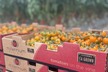
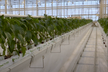
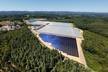
You'll find one of these geothermal greenhouses high on the Nebraska plains near the town of Alliance. Inside, there's a citrus grove with trees holding up a canopy of lemons, grapefruit-sized oranges, green figs and bunches of grapes. Russ Finch, a former mail carrier and farmer, designed the structure, which he calls the Greenhouse in the Snow. The original, which he built more than 20 years ago, is connected to his home.
"Any type of plant we saw, we would put it in and see what it could do. We didn't baby anything," Finch says. "We just put it in and if it died, it died. But most everything really grows well. We can grow practically any tropical plant."
The greenhouse design is a take on a walipini, or pit greenhouse. The floor is dug down, 4 feet below the surface. The roof is slanted toward the south to catch as much sun as possible. During the day it can reach well into the 80s inside the greenhouse, but at night the temperature plummets. That's when Finch draws on geothermal heat.
Warm air is taken from perforated plastic tubing that is buried underground. The plastic tubes go out one end of the greenhouse and run a loop to the opposite end. A single fan circulates air through those tubes. As the air moves through, Finch says it picks up enough heat from the soil to keep his oranges out of danger.
The greenhouse uses very little energy, almost entirely pushing fossil fuels out of the picture, and keeping energy costs down to about $1 a day, Finch says.
"There have been hardly any successful 12-month greenhouses on the northern High Plains because of the weather," Finch says. "The cost of energy is too high for it. But by tapping into the Earth's heat, we've been able to drastically reduce the cost."
Finch grows a few hundred pounds of fruit each year to sell at local farmers markets, but his main business is selling the design for his greenhouse in the snow. A new greenhouse costs $22,000 to build. So far, he says, 17 of them have been built in the U.S. and Canada. That includes one at a high school in nearby Alliance, Neb., where students grow tomatoes, cucumbers and other vegetables to serve in school lunches.