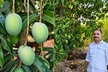
Its orange colour and flavour have captivated hundreds of consumers. The planting of kakis is becoming increasingly common in the province of Malaga, given the high demand in the domestic and international market for this attractive fruit.
Four years ago, the cultivation of persimmon kakis, a variety appealing for its flavour and attractive texture, started spreading in Malaga.
Most of the production concentrates in the towns of Alfarnate and Villanueva del Trabuco. There is a total of 23 hectares distributed also in Casabermeja, Colmenar and Antequera. The plantations have replaced cereal or apple crops and poplar fields in the Antequera area.
Kaki trees become productive approximately four years after they are planted; consequently, this will be the first year in which Malaga's plantations will bear fruit. The production is likely to reach around 60,000 kilos, with a turnover of close to 42,000 Euro.
The president of the Association of Kaki producers of Western Granada and Alta Axarquía (Aprokaki), Juan Miguel Ortigosa, highlights the "potential" of Malaga's lands to grow this crop. Ortigosa says that the fruit is perfectly suited to the climate of the northern part of the province and the Alta Axarquía.
The President of Aprokaki points out that "avocados and mangoes are a noteworthy crop in the Axarquía, but not all areas are suited" and kakis are a good alternative for these crops; however, he admits the fruit is not ideal for coastal areas.
"This is not a subtropical tree; it is for cooler climates." There are risks if planted in the areas which become colder in winter, which is when trees are in bloom; however, the fruit, as described by Ortigosa, can withstand several degrees below zero before the flowering.
The kaki harvest takes place in October, when that of other fruit varieties has already been completed. This is highlighted by producers, who wish to encourage others to introduce the highly demanded fruit as a complement to existing crops.
Growers in Malaga thus see kakis as a solution to tackle the impact of the low prices of other fruits. This makes them attractive, as they can charge about 70 cents per kilo, with them sold in the market for about two Euro.
Another of the fruit's advantages is the considerable yield per tree, since a fully developed specimen can produce up to 100 kilograms per campaign.
"The planting is cheap; every tree costs around three or four Euro and each hectare requires about 650 trees," explains the president of the association.
Moreover, pests have not been an issue in the trees planted in the province; it is also a crop that requires no pesticides. In fact, Aprokaki plans to make the plantations organic in the future.
Another long-term prospect for kaki producers is to be able to meet the international demand for the fruit. Thus, Ortigosa stresses the plans to make use of the marketing channels of avocados to ship kakis to Europe; a project that looks forward to the re-opening of the Russian market in order to further expand internationally.
Source: laopiniondemalaga.es