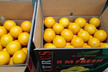
The heat wave that hit the Region of Murcia during the month of April has taken a toll on the lemon harvest. Producer prospects, which have been confirmed by the Council of Water, Agriculture and Environment, point to a 23% decline this year.
"The heat wave we suffered after the Easter holidays affected the flowering and the fruit setting, resulting in a smaller number of fruits per tree," said the General Director of the Interprofessional Association of Lemon and Grapefruit, Ailimpo, José Antonio García. However, growers believe that the volume harvested will be similar to the average of the past seven years and that "we are comparing the current prospects with the results achieved last season, which was a record campaign in terms of production and therefore exceptional."
The reduction in the harvest is thus of "temporary and extraordinary" nature, as the acreage remains stable, added Garcia.
Ailimpo expects a total harvest of 850,400 tonnes for the campaign that is starting shortly. A 17% drop is expected for Primafiori lemons, with the decline being "moderate in the first half and more pronounced in the second part of the campaign."
Varieties
In the case of Verna lemons, a greater reduction is expected, with an initial decline of 38%, although this forecast should be updated in January depending on rainfall, changes in calibres, etc., explains Ailimpo.
As in previous campaigns, citrus growers expect the lemon production to be absorbed by the fresh market, both for export and the domestic market, as well as by juice and essential oil processors, "with a right balance between supply and demand for both markets," said the General Director of Ailimpo.
Record exports
With regard to the current campaign, which is almost complete, it has been confirmed that it will close with a total production of Fino and Verna amounting to 1,100,000 tonnes, with record export and processing volumes and profitability for the whole industry. This figure is 12 percent higher than that of the previous campaign, when just over 923,000 tonnes were harvested.
Exports have continued to grow, both to traditional markets of the European Union as well as to third countries. The role of the processing industry as regulator of the fresh market has remained vital, already approaching 300,000 tonnes of lemon processed.
Producers, who always look to their competitors, explained that "the lemon campaign in the southern hemisphere (Argentina and South Africa) is already in full swing, although subject to special vigilance with regard to phytosanitary inspections to prevent the entry of products affected by the Black Spot virus," said García.
Up to 30 June, which are the latest figures that Ailimpo has had access to, the total volume exported, both to the European Union and to third countries, amounted to 595,169 tonnes, which is 8% more than in the previous season (when 549,637 tonnes were shipped).
As far as EU destinations are concerned, growers exported 486,232 tonnes, 10% more than in the 2013/2014 campaign. The data breakdown of European destinations available reveals growth in Germany (+11%) and France (+7%) and a significant increase in Italy (+53%), Poland (+12%) and the Czech Republic (+14%). There have also been dramatic increases in Latvia (+477%) and Greece (+1,024%).
"For us it is particularly positive to have sold more in our traditional markets, as this has helped us weather the impact of the Russian veto," said the General Director of Ailimpo.
Regarding the extension of the Russian ban, García noted that lemon producers are affected by this only in very specific months, from late February to late April, so that there will be little impact at the start of the present campaign.
Another encouraging fact for growers has been the performance of the processing industry. In fact, 289,140 tonnes has been processed up to 30 June, which is 28% more than last season.
Source: laopiniondemurcia.es