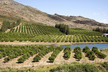
A study on the capacity for net carbon fixation in citrus farms, carried out by the Valencian Institute of Agrarian Research (IVIA), has found that drip irrigation improved net CO2 assimilation in these plantations by more than 30% compared to traditional irrigation.
The study, led by researchers of this centre (attached to the Council of Agriculture, Environment, Climate Change and Rural Development of the Region of Valencia), has also determined that increased planting does not improve net CO2 assimilation.
Among other noteworthy aspects, the study has also found that the age of the plantation is important in determining its ability for global carbon assimilation. While the carbon balance in young plantations is almost neutral, adult, 12 year old orange trees can incorporate up to 100 kilos of carbon (equivalent to more than 40 tonnes ha-1 of C) in their gross primary production. This figure includes the fallen parts and pruning remains produced over the years. Overall, these figures represent a gross assimilation of close to 150 tonnes of CO2 ha-1.
According to the study, the net carbon fixation per hectare in a citrus plantation in full swing would range between 5 and 7 tonnes, equivalent to a net assimilation of 20-25 tonnes of CO2. After deducting the corresponding CO2 from the carbon contained in the harvest and the fallen parts, a positive balance of between 5.5 and 9.0 tonnes of CO2 ha-1 is obtained.
Therefore, all adult citrus plantations in Valencia are responsible for an annual net fixation of between 800,000 and 900,000 tonnes of CO2; a figure to take into account when looking at the citrus sector's capacity to mitigate climate change.
The study, along with some derivatives thereof in which the IVIA is currently working, has been carried out in the framework of a series of European initiatives (Modelling European Agriculture With Climate Change for Food Security, MACSUR).
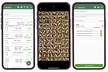
Currently, and in partnership with other institutions, work is being done in the study of new technologies to calculate the carbon footprint; this includes not only applications for mobile devices (such as a newly launched Android app developed in collaboration with the Polytechnic University of Valencia), which can be used by individual users, but also much more global tools that involve the use of internet platforms and satellite remote sensing tools.
Source: valenciafruits.com