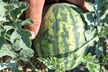
Watermelons are among the most established horticultural products in Almeria, not just in greenhouses, but also in the open ground during the summer months. While tomatoes, peppers and cucumbers, among others, cover much of European consumption throughout the year, mainly in autumn-winter, melons achieve no less, as about 20% (more than 222,000) of all watermelons consumed in the European Union (more than 950,000) are grown in the province of Almeria. This data was reported by Juan Carlos Pérez, professor at the University of Almeria, in an article prepared for one of Cajamar's latest publications about this product, entitled "Cultivation techniques and marketing of watermelons", coordinated by Juan Carlos Gázquez, head of the Department of Innovation and Transfer at the Experimental Station of the Cajamar Palmerillas Foundation.
In this publication, part of a thematic series about Agriculture, Juan Carlos Pérez analyses the international trade of watermelon, highlighting the role that it plays for the province of Almeria and its horticultural sector. Not surprisingly, Almeria supplies almost half of the fruit exported by Spain (42.6%), according to data processed last year by the Trade Promotion Agency of Andalusia (Extenda) from records of the Spanish Institute of Foreign Commerce (ICEX). In turn, Spanish watermelons account for 47% of the EU market.
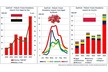
In the European Union, Almeria's watermelons are especially popular in the German market, which accounts for 28% of the total volume marketed, making it the largest buyer of watermelons in the EU. Behind Germany, the second largest importer is France, which purchases 10% of the total volume, and the Netherlands, which buys 9%. Other countries with noteworthy watermelon imports are Poland, with another 9%, the Czech Republic, with 8%, and Italy (which is also one of the largest exporters) and the UK, with 5% each. These seven countries buy about three-fourths of the watermelons distributed in the European Union, while the other 25% is bought by the remaining 21 Member States.
As discussed by Juan Carlos Pérez in his article, besides being large importers, "Germany is developing its export capacity to Austria and especially Poland." The Germans, according to 2013 data collected by Pérez from Eurostat records, exported more than 41,000 tonnes; a figure above which it has remained since 2009, despite the declines of more than 10,000 tonnes registered in the last three years (2010, 2011 and 2012).
Competitors in Europe
Almeria's competitors in Spain are Murcia and Valencia, which account for 25 and 20% of the country's exports to the European Union, respectively. Outside the EU, Costa Rica and Brazil, and in recent years also Senegal, are also in the list of competitors, while Italy, Greece and Hungary are the main rivals within the EU-28.
When it comes to watermelons marketed by Almeria's companies during its increasingly longer campaign, which extends from spring until well into November, the main overseas competitors at the start are Costa Rica, which sells over 30,000 tonnes of watermelon to the European Union. Another big supplier is Brazil, with about 29,000 tonnes, although its campaign reaches its peak at the end of the year, between October and December.
In the initial period of the provincial campaign, in which Almeria supplies European consumers with the first watermelons of the year grown in Community territory, Senegal also has a strong presence in the market. In the final stretch of the spring period, Almeria's production begins to clash with Murcia and Valencia, as well as other Andalusian producing areas, and also has to compete with the watermelons exported by Greece, Italy and Hungary. In the case of the latter two, their competition has the greatest impact in the months of July and August, as reported by Pérez, who warned that in recent years Hungary has advanced its campaign to overlap with Italy.
Almeria dominates the European watermelon market in May, accounting for 55% of the total distributed in the EU. Almeria's watermelons remain the most demanded by consumers in the European Union during the month of June, when according to the data provided by Juan Carlos Pérez they still account for 39% of the purchases.
The province exports almost half of all Spanish watermelons
The UA professor talks about some stability in the European market for Spanish watermelons. "Intra-EU trade has grown by 35% in the last seven years, mainly due to the increase in Spanish sales to the European Union; however, those coming from the outside has stabilised at around 185,000 tonnes," explains Juan Carlos Pérez, who concludes that "Almeria is one of the few areas that has managed to grow, both in absolute and relative terms."
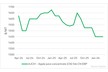
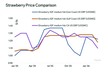
Over the last five years, the cultivation of watermelons has usually not registered changes as noticeable as those seen in the melon sector. The acreage devoted to this crop has kept growing in recent years, with slight increases that have been reflected in the production volumes (except for this campaign, in which production has apparently declined during the first stages due to problems in the setting), but not in prices, whose behaviour, as the UA Professor puts it, "remains very similar with every campaign." The best prices are usually registered during the first weeks of the spring campaign, after which they gradually drop, with small fluctuations throughout the cycle.
Last year, Almeria marketed a total of 447,000 tonnes of watermelons, according to official data included by Pérez in his article. Of this, 307,000 tonnes were sold via wholesalers and cooperatives, and according to Pérez, "around 227.000 tonnes worth over 121 million Euro were intended for export."
Latest campaign
Official data for the spring melon and watermelon campaign, which is still on-going for many open ground plantations in the province, have yet to be published; however, the president of the Association of Young Growers (ASAJA) in Almeria, Francisco Vargas, predicted that the balance "won't be better than last season's." Difficulties in the setting caused a reduction in supply volumes, and although prices have been higher than last year, the global analysis of both volume and price, taking also into account previous months, is still pending.
"We arrive on the market at a time when consumers have access to watermelons that have very little flavour, and this takes a toll on their expectations of having access to a quality, flavourful product, such as the one Almeria supplies," analysed Vargas. The value of the product now, at the start of the campaign, "is well below that obtained five years ago, and although it is the highest of the season, it quickly goes down as the market receives greater volumes of watermelons," concluded the president of the Association of Young Growers.
Source: ideal.es