Mario Schino lo Moriello presented data concerning the Italian garlic sector.
Italy imports a lot of produce, especially from Spain (58%) and the Netherlands (22%). In addition, the domestic market is strongly influenced by international trends and production costs continue to grow. This in turn means prices are very volatile, but at least the export trend is good, with Germany and Austria being the main outlets.
Italian flows
In 2013, Italy produced 28,250 tons of produce (51%) and imported 27,490 tons (49%). 77% of the total is destined to the market, whereas 0.4% goes to the processing industry, 1% is wasted and the remaining part (approx. 11,980 tons) is exported.
The produce destined to the market is divided between the H&R /20%) and retail (80%) channels.
The international scenery
China is the main garlic producer worldwide, growing around 1.6 million tons of produce.
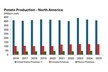
Left, the main competitors on the European market (Italy is yellow, Spain is blue and Argentina is grey). Right, the main Mediterranean producers (Algeria is yellow, Egypt is blue and Turkey is grey). (Click here to enlarge).
China is obviously also the main exporter. Between 2008 and 2013, exports increased from 1.3 to 1.8 million tons and profit grew from €434 to €1,055 million. Spain, Argentina, Netherlands and Italy follow at a distance.
Italian exports are looking good, and the produce is shipped mainly to Germany (34%), Austria (19%), Netherlands (8%), UK (7%), Czech Republic and Slovenia (both 5%).
As regards imports, in 2013 Italy imported 64% of the produce consumed from abroad, and mainly from Spain (58%), Netherlands (22%) and France (9%).
As mentioned above, prices at origin in Italy are very volatile. Spain is more stable although there can be strong changes over the years. Wholesale prices in France are in line with those of Spanish garlic.
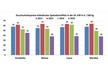
Wholesale prices: prices for the loose produce - Italy is blue and the foreign produce is in yellow. (Click here to enlarge).
Domestic demand has dropped as well as per capita consumption (from 0.75 to 0.72 kg per year).