According to the sales manager, some European countries tend to prefer certain varieties, "as for example Russians prefer darker strawberries than Italians."
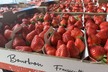
Romano Alfonso, located in Salerno, has been cultivating strawberries on around 30 hectares since 1982. The process is very quick - only 2 or 3 hours pass between harvesting and shipping.
Each phase - harvesting, stocking and packaging - is checked thoroughly. After packaging, the produce is placed in controlled atmosphere refrigerated chambers before being transferred to storage units.
As regards the effects of climate change, the sales manager says that the climate has been sub-tropical with sudden temperature changes for 4-5 years.
Destination markets are Italy, Germany, Switzerland, Sweden and Austria. 70% of the produce is sold to retailers and the remaining 30% goes to markets. "Foreign markets are quite peculiar, they are mainly looking for certifications and high-quality produce."
As regards the Italian market, the sales manager says that "I have not been working in this sector long, but I have noticed that people have gone back to choosing high-quality produce and are more interested in traceability."
Romano also states that, currently, the Candonga variety is being sold at €3-3.50/kg. "Sometimes we reach €4, but it depends on quality. As regards Fortuna though, prices are lower." The volume of Candonga strawberries available at the moment is of 5-6 pallets per day (each pallet weighs 400 kg).
"Our main competitors are the Basilicata and Sicily regions and Spain, although some produce has started to arrive also from North Africa and Greece. Among these, the main competitor is Spain, as it produces a lot and therefore it has an influence on prices. Growers work in big cooperatives and therefore they make decisions together and can have a stronger influence."
Italian strawberries have a higher quality and arrive on the market in better conditions due to the fact that transport times are shorter. In addition, it must be said that Spaniards produce less Candongas. "I think that Italy must focus on varietal diversification."
Strawberries are transported mainly by road, as " air transport would be too expensive and transport by ship or train is virtually impossible."
Romano Alfoso in part of the Alma Seges PO. Strawberries are sold under the "Tina" brand. The company also holds the GlobalGAP and GRASP certifications.
Contacts:
Antonio Romano - Sales manager
Cell.: +39 327 0452887
Email: [email protected]
Azienda Romano Alfonso
Via Arenosola snc
84025 EBOLI (SA)
Tel.: +39 (0)828 1991238
Fax: +39 (0)828 1991239
Email: [email protected]
Web: www.alfonsoromano.com
Romano Alfonso, located in Salerno, has been cultivating strawberries on around 30 hectares since 1982. The process is very quick - only 2 or 3 hours pass between harvesting and shipping.
Each phase - harvesting, stocking and packaging - is checked thoroughly. After packaging, the produce is placed in controlled atmosphere refrigerated chambers before being transferred to storage units.
As regards the effects of climate change, the sales manager says that the climate has been sub-tropical with sudden temperature changes for 4-5 years.
"Talking about the current campaign, there have been 20-25 days of continuous rain which slowed production down and which usually tends to cause shelf-life and fungi problems." Thankfully, shelf-life has been rather normal so far, as the produce has managed to reach markets and retailers in excellent condition.
Destination markets are Italy, Germany, Switzerland, Sweden and Austria. 70% of the produce is sold to retailers and the remaining 30% goes to markets. "Foreign markets are quite peculiar, they are mainly looking for certifications and high-quality produce."
As regards the Italian market, the sales manager says that "I have not been working in this sector long, but I have noticed that people have gone back to choosing high-quality produce and are more interested in traceability."
Romano also states that, currently, the Candonga variety is being sold at €3-3.50/kg. "Sometimes we reach €4, but it depends on quality. As regards Fortuna though, prices are lower." The volume of Candonga strawberries available at the moment is of 5-6 pallets per day (each pallet weighs 400 kg).
"Our main competitors are the Basilicata and Sicily regions and Spain, although some produce has started to arrive also from North Africa and Greece. Among these, the main competitor is Spain, as it produces a lot and therefore it has an influence on prices. Growers work in big cooperatives and therefore they make decisions together and can have a stronger influence."
Italian strawberries have a higher quality and arrive on the market in better conditions due to the fact that transport times are shorter. In addition, it must be said that Spaniards produce less Candongas. "I think that Italy must focus on varietal diversification."
Strawberries are transported mainly by road, as " air transport would be too expensive and transport by ship or train is virtually impossible."
Romano Alfoso in part of the Alma Seges PO. Strawberries are sold under the "Tina" brand. The company also holds the GlobalGAP and GRASP certifications.
Contacts:
Antonio Romano - Sales manager
Cell.: +39 327 0452887
Email: [email protected]
Azienda Romano Alfonso
Via Arenosola snc
84025 EBOLI (SA)
Tel.: +39 (0)828 1991238
Fax: +39 (0)828 1991239
Email: [email protected]
Web: www.alfonsoromano.com