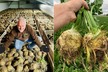
Sopropo is a relatively unknown vegetable you won’t easily find in your local supermarket. Its modest reputation is largely undeserved, as sopropo is remarkably healthy. Fred Koelewijn of Helena bv imports the product from Suriname and the Dominican Republic.
Pockmarked cucumber
Looking rather like a pockmarked cucumber, sopropo is anything but ordinary. The fruit comes in two shades of green and is very bitter. Bitterness however, is often associated with healthy vegetables and sopropo is no exception. The fruit is full of vitamins and minerals. It’s also a source of vitamin B1, B2, B3, B11 and vitamin C, and rich in magnesium, phosphorus, iron, manganese and zinc.
In addition, the fruit contains twice as much beta carotene as broccoli, twice as much calcium as spinach and twice as much potassium as a banana. However, the fruit is too bitter to eat. In order to reduce the bitterness of the vegetable, it is usually placed in salt water. After that the sopropo is lightly fried.
Niche product
Despite being extremely healthy, the sopropo is hardly known in Holland. Fred Koelewijn: "It is mostly, if not exclusively, eaten by people of Surinamese descent." Fred obtains the product from Suriname and the Dominican Republic. It arrives three times a week, which seems often, but considering the sopropo has a brief shelf life, supply has to be almost continuous.
Helena sells the product year round in a volume of about 500 kilos per week. "Of course, it remains a niche product," says Fred. "Therefore, it’s a pretty expensive item.” Still, demand seems to be growing gradually. Domestic production, however, proved elusive. “It’s too cold here,” says Fred, “and too dark. So it remains a product not easily found in the supermarket. And that's a shame, because it is a unique product.”