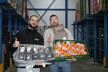
Miguel Gonzalez says goodbye to employees at Hispa
"The fruit and vegetable sector has not yet seen the end of me"
The Spaniard Miguel started his fruit and vegetable career at Hagé in the Netherlands in 1979, where he was responsible for the import of fruit and vegetables from Spain and South American countries. "At that time Hagé was an import company and I am grateful that they offered me that opportunity," Miguel looks back. In 1988 he started Hispa at the address where the company is still established, be it with portacabins in the shed. "All periods have their own charm, but the first years were really fantastic and our turnover increased like a rocket in that period."
Starting years
"At the start our focus was on trading Spanish fruit and vegetables. At that time all was imported in the Netherlands for further distribution to other European countries and we made good use of this. At that time the most important part of our trade (60%) was vegetables and 40% fruit. At the moment fruit is about 70% of the turnover of Hispa," Miguel says. "After about three or four years a change took place in the market and clients themselves traded with Spain. In those years Spain also became a member-state of the EU and it became technically easier to sell to other European countries directly."
The starting years
Hispa anticipated the changes in the market by starting fruit and vegetable imports from overseas from the classical South American markets, such as Brazil, Argentina, Chile and Uruguay. "We were part of the first importers of fruit overseas and this proved to be the correct choice. We started with grapes from Africa (Namibia) in 1994 - 1996 we imported the first melons from Middle America (Honduras and Costa Rica). Costa Rica has become a very important country for us. We became the largest European importer of melons and after the purchase of a 3,000 HA pineapple farm we now also belong to the bigger pineapple boys."
In the meantime Hispa imports fruit from quite a number of countries and continents, such as Australia, Egypt, Israel and Peru. "I view Peru as one of the countries of production with the most potential. The climate is suitable for the cultivation and I consider the local economy for the time being only as an advantage. As a result one is able to produce longer and to sell part of the production on the local market."
Planning
"During the years, Hispa has grown to a renowned importer under my direction. Nevertheless I have always stressed to look for correct selling opportunities first. The time of moving boxes is over. Good planning is essential for sales in the direction of retail. Till the end of the nineties most of the products from overseas ended up on the free market. When sales moved more and more towards European retail, imports also change. Previously one left the initiative in relation to the product to the producer and then waited for the arrivals. To-day it is of the utmost importance to cooperate from producer to consumer."
According to Miguel, retail should pay a lot more attention to communicate the properties of products on the shop floor. "listening to the consumer means we can produce more following the requirements of the consumer, and therefore consumption should increase. Now the relatively low fruit and vegetable consumption is attributed to the crisis. But I think this is too easy. According to me this is the result of the uncontrolled supply. Luckily there are exceptions, but often I miss passion and product knowledge of those responsible for fruit and vegetables in the supermarket."
Goodbye from the present staff
Good-bye from present staff
Miguel has not been involved in the active buying and selling for the last 10 years. "I had no successor in the company and have therefore been looking at the continuity of the company. There were various interested parties. I have known Dammis van der Staay for years and know that the company within the Staay Food Group is in professional and healthy hands. Following various take-overs the company has grown into an important player with various disciplines and I know that I leave Hispa in capable hands."
Right to exist
"I expect a good future for Staay-Hispa. I think one should either be a good sized player with the whole range or be a niche-player with a clear product speciality. The gray mass will not be successful. It is important that the company remains open to change in the market. More and more will be exported directly to clients from the production regions, wherever they are in the world. Those are the changes one must expect. Only when one serves the entire chain from beginning to end has one the right to exist."
then and now
"Also durability is an important theme. Our pineapple farm was the first to be Rainforest Alliance-certified. Furthermore I have always been concerned about the value of the individual within the company. The success of Hispa is owed to all employees, who made the company the large size which it is now. You are nothing without co-workers," Miguel realizes.
Although Miguel will no longer be involved in the daily management of Staay-Hispa he will remain involved in the trading company. "Two captains on a ship does not work and I do not hold any shares any more, but I have been asked to remain involved with the company as an adviser and I like this. For many business relations I am the face of Hispa and therefore I can be of value for the company as an ambassador. I will not be active day and night, but will regularly show my face in the office."
To fish
The extra free time he will have the fruit and vegetable trader hopes to spend mainly with family and friends. "I am sixty years old in the meantime, but I feel like thirty. This year I ran the Roparun for the 14th time and for the 18th time the marathon of Rotterdam and as far as I am concerned a lot more will follow. I have told friends, that if they see me sitting at a ditch with a fishing rod, then they must either push me into the water of phone 9-1-1," Miguel finishes with a laugh.
For more information:
Miguel Gonzalez
Hispa
M: 06-51267933
[email protected]
www.hispa.nl