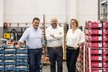
"We also produce in Argentina, Uruguay (small quantities) and in New Zealand. The most important quantities in the Southern hemisphere though are produced in Chile."
Giampaolo Dal Pane in New Zealand.
Shipping in the Southern hemisphere is done using containers, whereas in Europe the produce travels by road. We have exported approximately 230 containers from the Southern hemisphere this year, which are currently travelling to the various destinations.
In Italy, the commercialisation of Summer kiwis has ended: the campaign started in September and went on right up before Christmas with extremely interesting results and profits for producers that were 15% higher than those for the Hayward variety for the 1st category. "With respect to last year, there were more sales and special offers, though it must be stressed that buyers are more interested in the quality of the product. They pointed out to us when the produce wasn't perfect."
"Commercialisation on the Italian market is made through mass retailing, and we are also available in France thanks to our French branch Summerkiwi France which, by managing the system on site, places the produce practically in every supermarket chain. We also have some distributors in Spain and Portugal."
At the moment, as it is working for a niche market, the company hasn't been badly affected by the economic crisis. "With respect to the general kiwi market, we still produce small percentages. This is why we can say we haven't been really affected by the crisis," explains Dal Pane.
Summerkiwi in Flowpacks.
The produce is appreciated more and more: although consumers buy less nowadays, they are careful about price and the quality of what they buy.
At the moment, as it is working for a niche market, the company hasn't been badly affected by the economic crisis. "With respect to the general kiwi market, we still produce small percentages. This is why we can say we haven't been really affected by the crisis," explains Dal Pane.
Summerkiwi in Flowpacks.
The produce is appreciated more and more: although consumers buy less nowadays, they are careful about price and the quality of what they buy.
The prospects for the Italian kiwi market
According to Giampaolo Dal Pane, the relation between production and sale prices for Hayward kiwis was not fair. "In a number of cases, prices paid during the campaign were higher than what was then the reality of the market. Consumption was more or less in line with expectations, though prices were lower. The market was not terrible, but it wasn't even what we had been expecting for after harvesting." The majority of the processed produce was sold at around €1/kg.
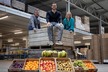
Dal Pane's visit to a SUMMERKIWI processing warehouse on 20th March 2013.
According to the entrepreneur, expectations in Italy are strongly linked to the economic situation, which is generating concentrated consumptions. "Because of this, extra-European markets will become more and more important for Italian producers and commercial operators. We should be looking at exporting overseas, just like countries in the Southern hemisphere do. The technology to improve storability must improve, so we can reach destinations that are 30 days away by sea. This is what I see for the future: we cannot think that we can continue to sell our produce only on continental markets, as there is a concentration of consumption of essential goods in Europe, and fruit is not even considered an essential good any more. The future therefore is selling products far away from here, also because the economic centre of the world is definitely moving towards Asia."
The campaign of national kiwis in Italy will last until mid/end of May, then kiwis from Chile should arrive, provided harbours will be unblocked. "At the moment there's a strike in the Valparaíso and San Antonio harbours which is blocking exports. We managed to leave before then with the Summer variety, though there have been delays in the shippings of Haywards."
The bacteriosis problem
"From the point of view of our nursery garden activities, bacteriosis (the Psa pathogen) created many problems though, thanks to the fact that we were able to expand in Argentina, Chile and South America, all of which are developing countries, we have had a very good opportunity. Thanks to the fact that we have invested abroad in 2005-2006, now those same companies can provide us with the plants we need in the European market. Argentina is in fact one of the few countries free from the Psa bacteriosis, therefore towards the end of May we will have many high-quality bare root plants to deliver to producers in many European counties." To take a look at the nursery garden: www.dalpanevivai.com.ar.
Photo of the nursery garden in Argentina.
Kiwis from the Southern hemisphere destined overseas are shipped with all of the necessary certifications and there haven't been any problems connected to the Psa. The bacteria affects the production of the plant, but it does not affect the fruit. At the moment, the bacteria doesn't seem to have hit Argentina. In Chile it only affects the South of the country, which is colder and where it rains more.
The earliest yellow kiwi in the world
To conclude, referring to the early AC1536 yellow kiwi developed by the Universities of Bologna and Udine of which Summerfruit has won the rights, Dal Pane stated: "We have the first plants ready for May and we will have the first producers ready to plant in May and June 2013. There are also other producers who will carry out grafts on Hayward plants, so prospects are looking good, as the AC1536 is going to be the earliest variety in the world. It ripens around 40 days before the Hayward does, it has good sizes and it is already yellow when harvested. It also has a good shelf-life. These are the best characteristics we could hope to find."
Contacts:
Giampaolo Dal Pane
Summerfruit S.r.l.
Tel.: (+39) 0546 55829
Fax: (+39) 0546 654716
Cell.: (+39) 335 326995 / 348 2688447
Email: [email protected]
www.summerfruit.it
www.dalpanevivai.com