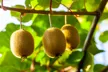
New-Zealand being the second producer had considerable growth in the same period, according to FAO statistics, to more than 400,000 tons. The production in Chile doubled to 235,000 tons. Greece almost doubled its production to 140,000 tons.
After the top four comes France. The French production slightly decreased since 2000. At a distance the USA, Iran and Turkey follow.
New Zealand is the most important export country of the world for kiwfruit. The export from there increased from 250,000 tons to more than 400,000 tons between 2000 and 2011. In 2011 the export of New Zealand kiwis had a value of $825 million.
Italy is second on the list with an export of 360,000 tons. Chile is number 3 with 180,000 tons. Also taking place is a fair amount of kiwi re-export. Belgium is a large re-exporter with a quantity of 120,000 tons. The Netherlands now re-export about 30,000 tons.
Italy is second on the list with an export of 360,000 tons. Chile is number 3 with 180,000 tons. Also taking place is a fair amount of kiwi re-export. Belgium is a large re-exporter with a quantity of 120,000 tons. The Netherlands now re-export about 30,000 tons.
Belgium is the most important importer of kiwi's. Spain and Germany are the other two importers with a quantity of more than 100,000 tons. After that Russia, the Netherlands, Japan, the USA, France and Italy follow. More than half of the import into the Netherlands are New Zealand products, which are imported via Belgium. Chile and Italy are the other suppliers with a reasonable quantity. The re-export from the Netherlands is mainly directed towards Germany, followed at a distance by France and Poland.
The expectation is that the production in New Zealand will be less this year (2013)
by about 10 percent than that of 2012, when also less was produced than in 2011.
For more information:
Fruit&VegetableFacts
Jan Kees Boon
[email protected]
For more information:
Fruit&VegetableFacts
Jan Kees Boon
[email protected]