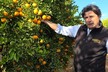
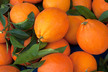
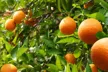
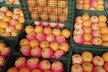
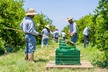
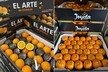
"We are now halfway through the campaign of Sicilian Blood Oranges, as we have almost completed the sales of the Moro variety and are now harvesting the Tarocco. In March we will begin harvesting Sanguinello oranges. The quality is quite high: the pigmentation is excellent and the taste is superb. Supply has decreased by 30% due to damage to the previous year's crop, which meant a good relation between supply and demand however, there was a fall in consumption," explains Alessandro Scuderi, chairman of the Consortium for the Sicilian PGI Blood Orange.
The weather is very important for the development of blood oranges, in terms of production, grade and especially pigmentation. Scuderi observes how "this year, there has been a delay in the start of pigmentation, because the weather was warm in December, so the product was therefore only ready in January."
Regarding prices, quotations at origin vary between €0.25 and €0.40 per kilo, depending on quality. "Prices have risen approximately 30-40% at origin, whereas the increase in wholesale prices is of 15-30%."
The economic crisis has led to a fall in consumption, and demand for smaller grades (i.e. less expensive) and decreased exports have been registered.
"85% of our product is marketed in Italy, both to traditional retailers and to wholesalers and H&R industry. Abroad, the main markets are Germany, Austria and Sweden, as well as Belgium, Norway and Great Britain."
The chairman also stresses how competition is really tough, especially from Spain, Egypt and Morocco. "Our product cannot compete with them because of high production and supply costs. What is more, genetically, blood oranges have smaller grades and, if prices are calculated according to the grade (as is now the case after Spain introduced this system), we really are at a disadvantaged."
Luckily, there are some exceptions, especially in those markets where, thanks to targeted campaigns, we have been able to promote our product as a speciality rather than as a simple orange.
An analysis of communication initiatives
During the 2012/13 season, we focused on consolidating Sicilian Blood Oranges through communication campaigns, which enabled us to:
- place the fruit in the world of sports: Blood Oranges are in fact the official sponsor of the A series Catania football team, which ranked 5th
- collaborate with health events i.e. "Arance della salute con AIRC" ("Airc oranges of health")
- collaborate with the H&R industry, thanks to the campaign "Born in Sicily";
- support children, thanks to the campaign "Un gol di salute" ("A healthy goal").
"We are proud to announce that Hendrick's, one of the most famous spirit companies in the world, has decided to make the 'blood orange liqueur', a distillate made with Sicilian PGI blood oranges."
Talking about past and future challenges, Scuderi comments that the key words are differentiation, innovation and internationalisation, all of which can be summed up in a single word: MARKETING.
The Consortium makes a consideration
February 2013 was successful for the blood orange Consortium. Foreign enthusiasm was such, that the website registered a 70% increase of visits during the days of FruitLogistica and BioFach.
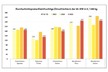
Klaus Davi & Co. carried out an excellent analysis of the impact abroad by monitoring 100 foreign newspapers during 2012/13. Results showed that the Consortium is becoming more visible in the foreign press.
Copyright FreshPlaza