Demand for ginger in the U.S. strengthened after the holiday period, which was clearly visible during the first weeks of January. At that time, Peruvian ginger benefited from strong demand, partly because Chinese ginger availability was limited and much of the Chinese product entering the market was still relatively young, which created some quality inconsistencies. However, as the season progressed, conditions began to normalize. "Chinese ginger quality improved and availability increased, allowing buyers to diversify supply," says Roger Zardo with JLZ Produce. As a result, some of the demand that had initially concentrated on Peruvian ginger began to shift, contributing to softer prices in recent weeks.
Peruvian shipments down
Shipment data reflects this trend. Exports from Peru to the United States peaked in week 8, when approximately 55 containers of organic ginger were shipped. By comparison, shipments were around 44 containers in week 7 and declined to roughly 36 containers by week 9, suggesting the seasonal export peak may have already passed. This time of year, the United States remains the dominant destination for Peruvian organic ginger, absorbing roughly 75 percent of export volumes, while most of the remaining shipments go to Europe. Looking ahead, farm-gate prices will likely continue to soften gradually as rainfall decreases and harvesting activity increases.
 © JLZ Produce
Increased supply due to accelerated harvest activity
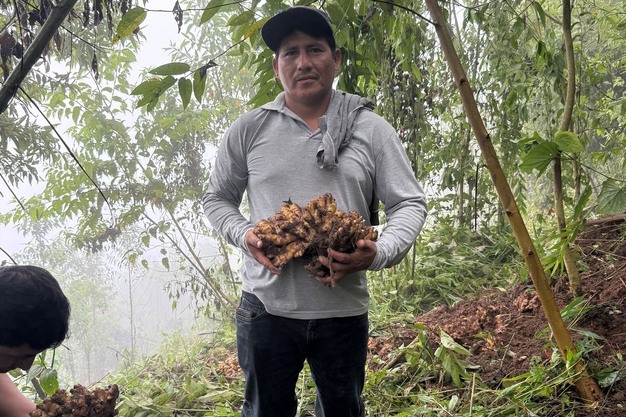
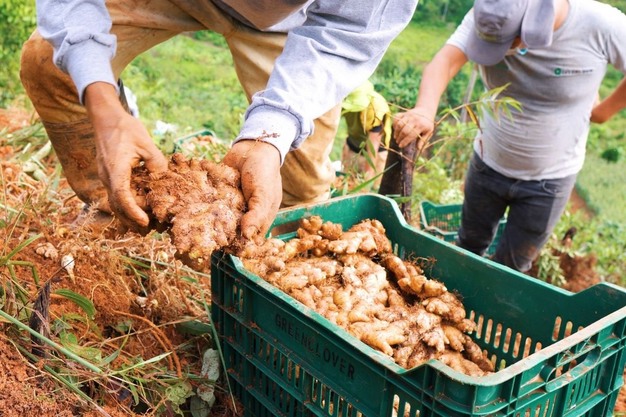
Looking ahead, farm-gate prices will likely continue to soften gradually as rainfall decreases and harvesting activity increases. Weather conditions in Peru's central jungle — where most ginger production takes place — have followed the typical seasonal pattern, with the rainy season occurring between December and March. Rainfall during this period is normal, although this year's precipitation was somewhat heavier during certain weeks. These conditions temporarily limited access to fields, making harvesting and transportation more difficult. At the same time, higher humidity increases the risk of mold, one of the main threats to ginger quality. Mold spreads quickly in humid environments and could affect product both before and after harvest.
As rainfall begins to ease and field access improves, harvesting activity typically accelerates and more supply enters the market.
Supply transition
The ginger market is currently moving through a seasonal transition typical for this time of year. Peru usually enters a tighter supply window towards the end of the campaign, typically between late March and early April. However, this year appears to be somewhat different. "Field observations suggest that significant volumes of ginger have remained in the ground longer than usual," commented Zardo. While harvest activity normally slows closer to March, it is possible that older crop ginger may continue to be harvested through March, April, and potentially even into May. If this pattern continues, the market could experience a longer-than-usual overlap between remaining old crop supply and the start of the new season.
Quality towards end of season
Towards the end of the campaign, quality tends to become more variable. At this stage it is common to see higher levels of sprouting, which occurs naturally as ginger ages in the field. It is also more common to see peeled skin, increased pest presence, and higher incidence of mold, especially during periods of high humidity. These conditions reduce packing yields. During the peak of the season, it may take roughly 20–21 field loads of ginger to complete a container. At this stage of the campaign, it can require 25–26 loads due to higher levels of sorting and rejected product. This means that even if raw ginger prices decline, exporters often need significantly more raw material and more intensive sorting to assemble export-quality shipments. "For this reason, some exporters reduce shipments during this period, as poorly handled containers can lead to substantial discounts at destination," Zardo said.
 © JLZ Produce
Start of new season
In recent years, early shipments of young Peruvian ginger have sometimes begun as early as April, often moving initially by air. However, given that meaningful volumes of older crop ginger still appear to be available this year, the transition into the new season may occur slightly later. At this stage, early new-crop shipments could potentially begin around May or June, although timing will depend on field conditions and market dynamics.
One key question will be whether buyers continue purchasing lower-priced older crop ginger or begin transitioning earlier to young ginger, which typically carries higher logistics costs when shipped by air.
Operational complexity
"One important aspect of the ginger trade that often receives less attention is the operational complexity involved in shipping during the later stages of the season," shared Zardo. Higher humidity, mold risk, sprouting, and lower packing yields make the product much more sensitive to handling conditions. As a result, assembling a container that arrives in good condition requires much more than simply having access to raw product. Supplier selection, washing protocols, sanitation standards, drying conditions, and cold chain management all play a major role in determining shipment performance.
Working with formal suppliers is particularly important. Formal operations typically involve controlled packing facilities, proper sanitation practices, washing with potable water, and handling the product within a traceable supply chain. Operational transparency also matters — for example, there should be a reasonable relationship between the volumes processed by a facility and the number of workers operating in that plant. When these conditions are not present, inconsistencies in handling can significantly increase quality risks.
Another factor the market is watching closely is the geopolitical environment. Rising energy prices linked to tensions in the Middle East could increase fuel costs, affecting inland transport, port logistics, and ocean freight. If logistics costs rise while farm-gate prices decline, the two forces could partially offset each other, making final price dynamics less predictable. Late in the ginger season, availability is not the real challenge — consistency is. At this stage of the campaign, reliability often depends less on how much ginger is available and more on how well the supply chain is managed.
 For more information:
Roger Zardo
JLZ Produce
Tel (+1) 831-320-2028
[email protected]
https://jlzproduce.com/