For decades, quality in fresh produce has been defined less by science than by interpretation. Buyers set the bar, growers try to meet it, and disputes emerge in the gap between the two. Increasingly, that gap is being targeted by AI systems designed to turn subjective judgment into something closer to measurable, shared standards.
 © GoMicro AI
According to Dr. Sivam Krish, founder of GoMicro AI, at the centre of the shift is a simple idea: buyers already decide what "good" looks like, so training AI on images that reflect good and bad quality and specific defects allows it to assess produce consistently across the supply chain.
"The one problem is subjective assessment," says Krish. "The seller, the farmer, thinks his stock is good, it goes to the other side, they say it's bad for various reasons… and there's no way to resolve that problem because on the other side, another human being is assessing it subjectively."
That subjectivity carries a financial penalty. Rejections at the buyer end often leave growers absorbing the loss, with little ability to challenge the outcome. By the time produce is turned away, it may have limited alternative uses, leading to discounting, write-offs, or waste. In this way, subjectivity in quality control operates as a kind of "tax" on the supply chain, as inconsistent assessments create hidden costs at every step.
But being able to apply a unified standard early in the supply chain promises to allow diversion of produce to other uses, rather than allowing it to proceed to rejection and, in some cases, waste.
 © GoMicro AI
What changes with AI is not just automation, but alignment. Rather than relying on multiple human inspectors at different points in the chain — each applying slightly different judgment — systems can be trained to replicate a single, consistent standard.
"We replicate the judgment of one human being," Krish says. "And then that judgment can be applied throughout the chain. "There's no point in the farmer saying it's good; the buyer has to say it's good."
In practical terms, that removes much of the ambiguity that drives disputes. If both shipper and receiver are assessing against the same model, trained on the same definition of quality, disagreements shift from opinion to verifiable difference — or disappear altogether.
For growers, the cost benefits are immediate. Assessing fruit against the buyer's standard before it leaves the packhouse reduces the risk of rejection and the associated freight, handling, and disposal costs. It also allows the product to be redirected earlier.
"The shipper also knows, okay if I send this… "It's going to be rejected anyway because this is how they judge," Krish says.
That ability to make decisions upstream is critical in perishable categories such as berries and leafy greens, where delays quickly erode value. Instead of shipping borderline product into high-spec retail channels, growers can allocate it to processing or lower-spec markets, preserving margin that would otherwise be lost.
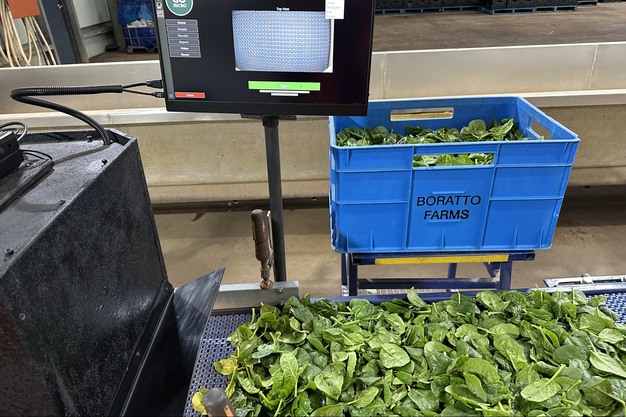
The technical barrier has historically been accuracy, particularly in produce where defects are subtle or obscured. "If the defects are obvious, it can be done," Krish says. "But if they are subtle, it's hard to do." That includes issues like leaf-on-leaf contamination in spinach or minor bruising in strawberries.
 © GoMicro AI
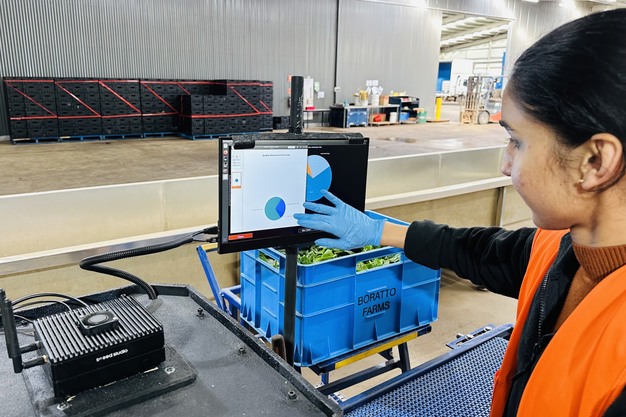
"What we have cracked is the ability to detect very subtle defects, even those that are hard to detect by eye," he says, adding that systems can assess produce even when items overlap — a longstanding limitation in automated grading.
Crucially, the approach does not depend on a single universal standard. Instead, AI can be trained rapidly on specific buyer preferences using sample sets, effectively digitising subjective judgment.
"This is how the model works. You give it examples of images that show it this is good quality… this is really bad… and the model will learn to reproduce them faithfully. So in that way, you can create categories," Krish says.
In a sector defined by biological variability and shifting expectations, the result is a shared, transparent framework that reduces friction, cuts waste, and lowers the hidden costs of disagreement — replacing subjective calls with consistent, repeatable assessment.
For more information:
Kristie Dutt
GoMicro AI
https://gomicro.ai/
[email protected]