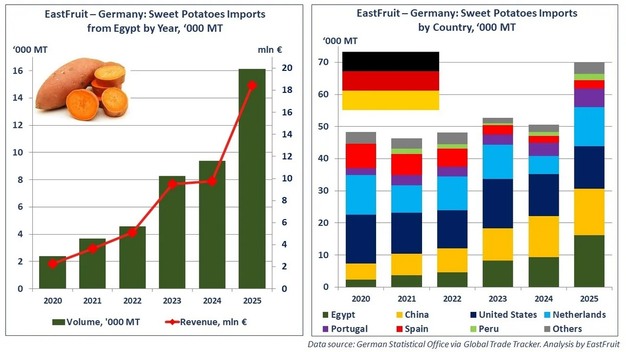
Egypt has expanded its position in Germany's sweet potato import market, surpassing suppliers such as the United States, China, Spain, and the Netherlands, according to EastFruit. In 2025, Germany imported 16,100 tons of sweet potatoes from Egypt, valued at more than €18 million (US$19.4 million), representing a 72 per cent increase compared to 2024.
Exports from Egypt to Germany have grown for 13 consecutive years, with volumes increasing more than sixfold over the past five years. The average annual growth rate during this period reached 46 per cent.
 © EastFruit
Seasonal supply patterns show shipments peaking in autumn and winter. In October 2025, exports reached 3,600 tons, equal to Germany's total imports from Egypt in 2021 and exceeding volumes recorded in 2020.
The supplier landscape has shifted over recent years. Spain's share declined in 2023, followed by the Netherlands in 2024. By 2025, Egypt accounted for 23 per cent of Germany's sweet potato imports, compared with 5 per cent in 2020.
Several factors have contributed to this change. Shorter transit routes between Egypt and Germany reduce transport time and support supply chain efficiency compared to shipments from more distant origins.
Price positioning has also played a role. The depreciation of the Egyptian pound has resulted in Egyptian sweet potatoes being priced 20 to 30 per cent lower than products from the United States and Spain, influencing purchasing decisions in the German retail sector.
Production practices have also shifted, with growers adopting varieties aligned with market demand and implementing certification standards such as GLOBALG.A.P. and GRASP to meet retail requirements.
Source: EastFruit