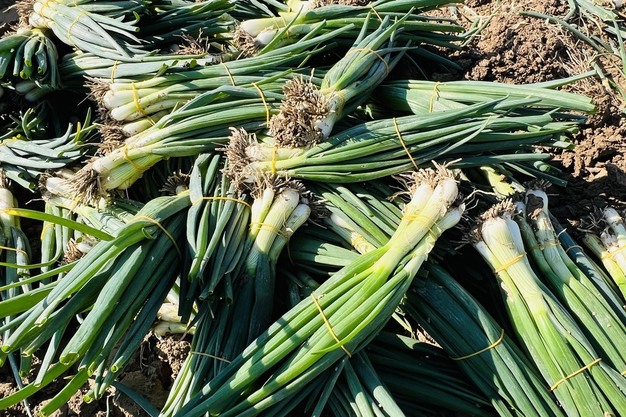
The spring onion harvest is now underway across the entire Gemüsegarten Pfalz region. Traditionally, these crisp bundles are the first fresh vegetables of the new season to be harvested outdoors in Germany. To ensure that the farms in the Gemüsegarten Pfalz specializing in spring onion cultivation can supply retailers and consumers nationwide with super-fresh spring onions every day, crisp-fresh onions are harvested daily on order from March through October/November.
In total, around 350 million bunches of this versatile superfood are grown in the Palatinate, which is Germany's largest contiguous open-field growing region for fresh vegetables, season after season. The annual cultivation area ranges from 2,000 to 2,500 hectares, making the Palatinate the undisputed European champion in spring onion cultivation.
 © Gemüsegarten Pfalz
The spring onions currently being harvested in the Palatinate were sown in staggered intervals over several weeks starting in the summer. Since they remain in the fields in the Palatinate throughout the winter, they are also referred to as winter onions.
Short transport routes guarantee quality and freshness
The early harvest literally requires time and a delicate touch. Selection begins at harvest: tips discolored by the cold winter, as well as the outer leaves, are removed by hand. They are bundled, depending on customer and weight specifications, usually in bundles of five or eight, directly in the field. Unlike imported goods, which are primarily shipped from North Africa over thousands of kilometers and numerous days via sea transport and truck to Germany, spring onions from the Palatinate vegetable garden offer sustainable quality and freshness advantages.
Immediately after harvest, the crisp, fresh bunched onions are washed at local processing facilities, cut to the desired marketing length, packed into reusable crates, and then transported directly by refrigerated truck to the wholesale markets and distribution centers of supermarkets nationwide. Producer Jochen Fehmel comments, "Most of the time, the spring onions harvested early in the morning are already on the highway just a few hours later. So, as a fresh bonus, they reach stores in record time!"
 © Gemüsegarten Pfalz
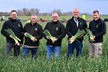
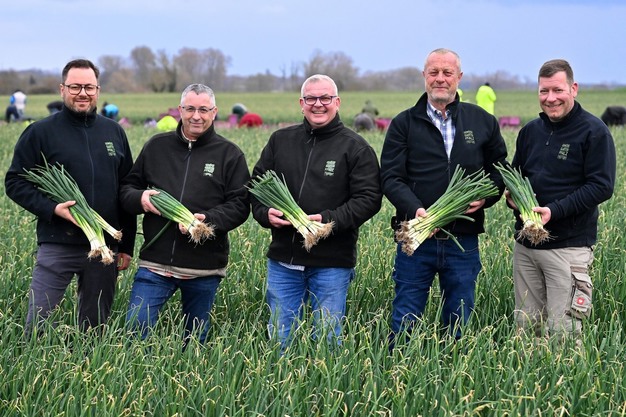
Palatinate spring onion producers, including Jochen Fehmel (left)
Unfair competition: Sustainable farming is burdened with high additional costs
In terms of food security, German fruits and vegetables should be particularly valued, and domestic farming should be supported and promoted. Politically, however, the opposite has been happening for years. A current example is the legally mandated increase in the minimum wage to 13.90 euros as of January 1, 2026, which applies without exception to seasonal workers from other European countries who work in Germany for only a few weeks a year and therefore receive their gross wages as net pay.
Dr. Christian Stoermer, Managing Director of Gemüsegarten Pfalz Management GmbH, says, "Since many seasonal workers usually also receive room and board, they, unlike permanent employees, are virtually unaffected by the high cost of living. Due to the high demand for labor during the harvest, this latest increase in the minimum wage poses enormous economic and organizational challenges for fruit and vegetable farming in the Palatinate. Compared to other EU countries, where there are either no minimum wage thresholds at all or significantly lower ones, this leads to massive distortion of competition and puts domestic farming at a disadvantage!"
For more information:
https://gemuesegarten-pfalz.de/
https://www.pfalzmarkt.de/