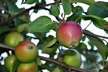
Apple grower Ma Yong-un in South Gyeongsang Province reported yield and quality losses following an unusually rainy autumn and one of the hottest summers on record. Fuji apples in his orchard showed limited red coloration and fruit cracking ahead of harvest. He estimated that about half of his crop did not meet quality standards.
"I had never seen this kind of cracking before," Ma said. "I was so stressed. I was worried about my family's survival."
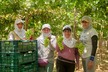
Ma is one of five plaintiffs in a civil lawsuit filed against the state utility Korea Electric Power Corporation and five of its power generation subsidiaries. The case seeks financial compensation for climate-related agricultural losses and questions whether a corporate emitter can be held responsible for downstream impacts linked to climate change.
Filed in August, the claim argues that KEPCO's greenhouse gas emissions contributed to climate change and to economic losses experienced by the plaintiffs. Between 2011 and 2023, KEPCO and its subsidiaries accounted for about 27% of South Korea's total greenhouse gas emissions. Globally, their emissions represented about 0.39% of cumulative emissions over the same period. An accompanying analysis estimated US$72.9 billion in climate-related economic damages linked to KEPCO's emissions.
Each plaintiff is seeking 5 million won (US$3,400) in damages, with an additional 2,035 won (US$1.40) claimed as symbolic compensation.
"Agriculture is an industry that is absolutely dependent on climate conditions," said attorney Yeny Kim. "As the climate changes, we're reaching a point where certain crops can no longer be grown. That leads to damage to farmland, reduced yields, and increased costs just to grow the same amount of crops."
The first hearing took place at Gwangju District Court, with the next session scheduled for April 23.
Nationally, renewable energy accounted for 10.7% of electricity generation in 2024. South Korea's calorie self-sufficiency rate stood at 32.5% in 2023, while the broader grain self-sufficiency rate was 22.2%, according to cited data.
Rice farmer Hwang Seong-yeol, also a plaintiff, said weather volatility has altered production risk. "We just look at the sky and wonder what the weather is going to be like," he said. "Being stressed from physical labor is something we can endure. But the stress caused by climate change is completely unbearable."
Ma said his individual losses exceeded the compensation sought. "The compensation is 5 million won, but the damages I suffered this fall alone were ten times more than that," he said. "So the amount itself doesn't really mean much."
Source: TheKoreaTimes