The extreme weather in southern Europe largely shaped the current soft fruit market in recent weeks. "Since January, flooding and storms have caused delays and quality issues. At the moment, there are very few truly good strawberries from Morocco and Spain. Some growers have lost half of their tunnels. They are busy repairing the greenhouses and bringing to market what is still reasonably acceptable, while discarding a large share. It is a tragedy for our growers in that region," says Sjraar Hulsman of Frankort & Koning. "It has been dry again in Huelva for the past few days, which should result in increasing volumes of better quality fruit in around a fortnight."
"Alternatives are limited. In recent years, more Greek strawberries have appeared on the market, but they require longer transport to the Netherlands, and that can sometimes be reflected in the fruit, depending on the variety and transport conditions. Strawberries are also available from Italy, though only in limited quantities, and they too have been affected by adverse weather conditions," Sjraar continues. "Market prices for Spanish and Moroccan strawberries are currently between 6 and 7 euros per kilo. Italian strawberries are about one euro more expensive. For strawberries from Dutch open-field cultivation, we saw prices between €14 and €15 per kilo in January, with an outlier in February in the week before Valentine's Day, when prices rose to €19 per kilo."
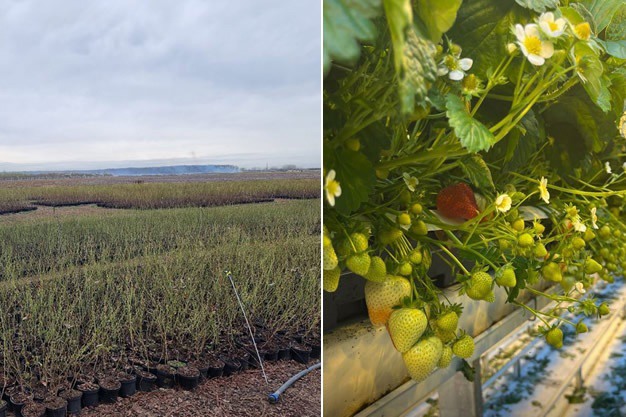 © Frankort & Koning
"The supply from Dutch and Belgian open-field production is not excessive. However, in this situation, more exclusive export customers are opting for reliable strawberries from the Netherlands and are willing to pay a premium. Partly as a result, we see our customer base expanding each year, and regular buyers are increasingly finding us because of the broad supply from different countries and the service we provide throughout Europe. In terms of varieties, Sonata and Sonsation still make up the bulk of the lit crop. Our growers are also conducting open-field trials with other ever-bearing varieties during winter, although it remains to be seen whether these will gain wider acceptance. Meanwhile, the lit Inspire crop has also entered the market, offering a range of options," observes Sjraar. The first unlit Sonsation crops will start in week 11.
"In recent years, fewer raspberries have been planted in Spain, as growers cannot compete with Moroccan production costs, leading many to switch to other crops, including blueberries. Poor weather in Spain and Morocco has also made raspberry quality a challenge, despite growers making considerable efforts to deliver good fruit. Prices have long been around 14 to 15 euros per kilo for packaged Moroccan raspberries and around 15 to 16 euros per kilo for Spanish ones."
 © Frankort & Koning
Team Frankort & Koning at Fruit Logistica
"For us, the import season for Peruvian blueberries is now truly coming to an end. Whereas a few years ago prices reached extreme levels, the product is now finding its way onto the market despite the large-scale plantings," Sjraar continues. "Prices for packaged products were still around 6 to 7 euros per kilo in January, but have increased steadily in February to 12 to 14 euros per kilo at present. Normally, Morocco would now be in full production, but supply is lagging. The Chilean season is running smoothly this year, so we do not expect shortages."
"Furthermore, we are seeing increasing activity in Egyptian blueberry production. New varieties from the Sekoya and Planasa programmes are being introduced, as in other countries. These offer improved flavour and longer shelf life, which undoubtedly supports consumption. In addition, when strawberries are very expensive, retailers tend to focus more on promoting blueberries," Sjraar concludes. "For redcurrants, sales have remained fairly stable for weeks, with packaged trade prices around 10 to 12 euros per kilo."
 For more information:
Sjraar Hulsman
Frankort & Koning
Tel: +31 (0) 77 3897 328
[email protected]
www.frankort.nl