A four-year study conducted by Agriculture Victoria Research in Australia assessed the long-term effects of overhead solar panels on productivity and fruit quality in a blush pear orchard in Goulburn Valley, Victoria.
"Our findings are very likely applicable to other fruit crops, but more research needs to be carried out," said corresponding author Alessio Scalisi. "Other crops like apple and cherry might benefit more from overhead solar panels."
The trial compared three treatments with three replicates each: a control without panels, a 45°W tilt, and a 5°W tilt. Each plot covered 105.5 m² across three tree rows, with measurements taken from five central trees. Two 52 kW systems were installed using 435 W modules and inverters. A portion of the generated electricity powered the irrigation pump, with surplus energy exported to the grid.
Between 2021 and 2025, the site recorded seasonal variation in solar radiation and temperature. The 5°W arrays generated around 10% more energy than the 45°W system due to more uniform light interception. Peak output occurred in December.
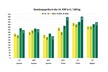
Shading altered tree productivity. Both fruit number and total yield per tree declined under panels, with the 5°W system recording the largest reductions. Over four years, control trees produced a cumulative yield of 137 tons per hectare compared with 77 to 89 tons per hectare in shaded treatments. Fruit blush coverage decreased under panels, green background color increased, and soluble solids content declined, while firmness was unchanged.
Shading reduced sunburn and hail damage, and shaded trees maintained lower leaf temperatures and higher photosystem efficiency. Early-season trunk growth increased under panels, potentially linked to water availability. Leaf water status and transpiration were similar across treatments.
The study, published in Scientia Horticulturae, concludes that agrivoltaics can reduce heat stress and generate electricity, but trade-offs in yield and coloration must be considered. "Long-term economic analyses will be essential to determine the viability of agrivoltaics for fruit growers worldwide," the academics stated.
Source: PV Magazine