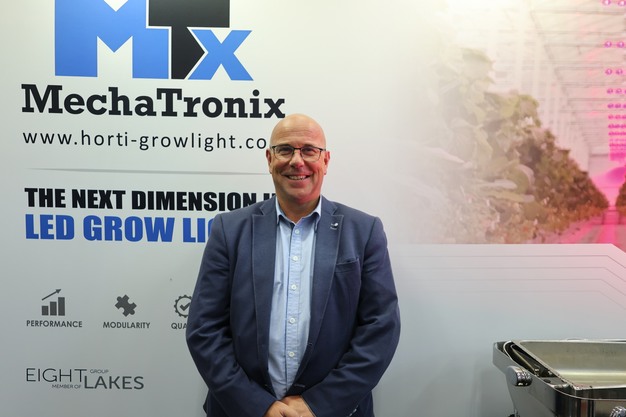
The assumption was that the European market would slow down. Instead, it is accelerating. Not just this year, but next year as well, with growth that Koen Vangorp, CEO of MechaTronix, describes as steep enough to justify major manufacturing investments. "We originally thought the EU market would cool down," Koen explains. "What we see now is the opposite."
That expectation shift is already materializing on the ground, with suppliers like MechaTronix investing in manufacturing capacity. This all brings up the question, what is driving the renewed momentum?
 © MechaTronix
From hybrid to fully lit
For vegetable growers, the assumption that most greenhouses had already transitioned to LED lighting turned out to be inaccurate. "There is still a big increase happening, especially in Benelux," Koen says. Early projects were often based on hybrid installations, with part of the greenhouse lit and part unlit. That model, however, is increasingly being abandoned.
The shift toward fully lit greenhouses is not purely technological, but rather operational. When only part of a site is under light, growers face staggered production timelines. That typically means hiring extra workers during winter and then letting go of a good chunk of staff when the unlit sections slow down. "With a fully lit greenhouse, growers can retain the full workforce year round," Koen explains. "It becomes easier to train people and to keep experience inside the company."
Economics also plays a role. "Hybrid systems introduce complexity without fully shielding growers from energy price volatility," he points out. "By switching entirely to LED, growers simplify their production planning and only have to manage energy pricing, rather than juggling parallel cultivation strategies."
Fending off pathogens
Other than labor and economics, disease pressure has become a decisive factor. With viruses such as ToBRFV affecting tomato and cucumber production, hygiene protocols have become ever more crucial. In greenhouses with mixed lighting schedules, cleaning cycles are fragmented. "If one part is lit and another is not, you never fully clean the facility at once," Koen says.
As a result, growers with multiple locations have to choose to concentrate on production in a single, fully lit site. "That allows them to synchronize cleaning, disinfection, and crop cycles. What initially looked like an energy driven decision is now equally about risk management."
Flowers tell a different story
In floriculture, the motivations are different. Roughly 60% of MechaTronix activity is tied to vegetables, with the remaining 40% in flowers. In the Dutch flower sector, recent investments are less about disease pressure or labor efficiency and more about strong market performance.
"Flower producers have gone through a very good economic period over the last 12 to 15 months," Koen notes. That profitability has translated directly into new investments, particularly in crops such as chrysanthemums. Importantly, these are not just retrofits. "We see fully new greenhouse projects being built from scratch."
Retails, climate, and local supply
Despite regulatory hurdles and increasingly complex permitting processes across Western Europe, demand continues to grow. One reason is the changing behavior of large retailers, according to Koen. "Retailers are looking more and more for local produce, with quality and supply stability as the key drivers."
Southern European production, traditionally relied upon during winter months, has become less predictable. Extreme weather events, such as storms hitting Spain during harvest periods, are putting pressure on volume and consistency. Climate change is no longer a future concern, but a present variable affecting daily supply decisions. "As a result, controlled environment agriculture in Northern and Central Europe is gaining strategic importance," Koen says. "Retailers value not just proximity, but the ability to deliver uniform quality week after week."
Energy prices reshape North America
For years, the North American market followed a different logic. Cheaper electricity allowed growers to prioritize lower cost luminaires with limited energy efficiency. However, things are slowly taking a different shape. "Take Canada, for example, the Leamington area. We used to calculate rather cheap energy prices there. Now, it appears energy costs are approaching European levels, which means that North American growers are reassessing their lighting strategies."
The rise of dynamic spectrum
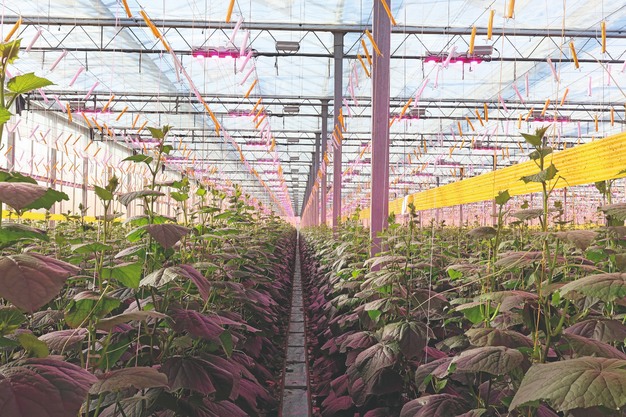
One of the clearest trends is the move toward dynamic spectrum lighting. While often perceived as expensive, Koen challenges that assumption. "The difference between manufacturing a dynamic spectrum light and a fixed spectrum one is marginal. We are talking about a few dollars."
At MechaTronix, 95% of sales now involve full dynamic spectrum systems with 4 independent channels. "We already had this 7 years ago," Koen says. "The knowledge on the crop side just was not there yet, that's why it has taken a little time before this tech gained ground."
 © MechaTronix
The role of the rebate market
Investment decisions in Europe are also strongly influenced by subsidies, though the approach varies widely by country. For instance, in the Netherlands, greenhouse growers currently have access to multiple rebate programs, and subsidies can cover up to 70% for large scale projects involving tomatoes, cucumbers, or strawberries.
Belgium technically has access to similar European funds, but distributes them differently. "The money is spread out in small amounts to many growers," Koen says. "That creates a dangerous competitive imbalance." Dutch growers can receive millions in rebates, while Belgian and German growers cannot match that scale. As a result, some Belgian growers are joining Dutch cooperatives to access the same funding mechanisms.
Growth beyond core markets
With Southern European supply dwindling, the market for greenhouse production has grown beyond the usual border of the Benelux region, says Koen. "Germany, Switzerland, Austria, Czech Republic, and Poland, are all seeing new projects, though they are not going as fast in Benelux. What's interesting is instead the greenhouse investments happening in countries such as Armenia and Kazakhstan."
 © MechaTronix
Changing consumer expectations
Underlying many of these investments is a broader shift in consumer standards. "Take strawberries, for example," Koen says."40 years ago, almost all strawberries were grown in open fields. They were dirty, damaged, and that was normal. Today, those same strawberries would no longer meet retail expectations."
MechaTronix recently completed a 10ha strawberry project in Quebec, where traditional production methods are still common. That too, however, is changing. "At some point, the original market disappears," Koen says. "Consumers get used to new quality standards, and the old ways are simply not enough to meet that demand. Hence, retailers seek that quality, pushing growers to invest in new modes of production."
During the energy crisis of 2022, the market witnessed this shift, and it was clearly visible. "That year, almost no lit strawberry production took place in Northern Europe, forcing winter imports from Spain and Morocco. The result was a drop of more than 50% in retail strawberry sales, driven largely by declining quality and taste."
Different factors are driving the greenhouse sector in Northern Europe. Disease pressure, labor availability, consumer expectations, and climate change are all contributing to a decline in reliability from Southern European supply. Greenhouse growers have stepped in to meet increasingly high quality standards from consumers, and doing so requires technology that is efficient enough to justify the investment. One of the clearest indicators of this shift in market dynamics is the accelerating adoption of LED lighting.
For more information:
MechaTronix Europe NV
Minervum 7139
4817 ZN Breda
Tel: +31 (0)76 790 16 10
[email protected]
www.mechatronix-europe.com