Researchers at the Arkansas Agricultural Experiment Station in the U.S. are testing a drone-based system to quantify flower density in blackberry breeding programmes. For breeders, white and pink flowers are an indicator of productivity, but manual counting is time-consuming and can lead to inconsistent data.
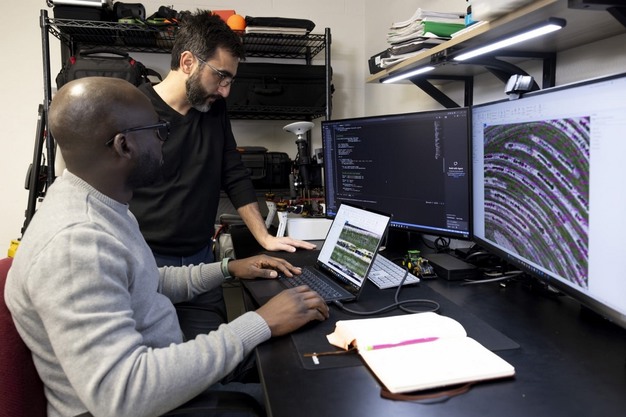
Cengiz Koparan, assistant professor of precision agriculture technology, together with Akwasi Tagoe, a graduate student in the department of agricultural education, communications, and technology, developed a camera-equipped drone system to measure what they call the flower-to-vegetation ratio, or FVR. The measurement was validated by comparing drone-based results with human flower counts.
 © University Of Arkansas
"Now we can quantify flower coverage and vegetation coverage with a standardized measurement," said Koparan, who works in the departments of agricultural education, communications and technology, and biological and agricultural engineering. "We also now know the flowers produced per given vegetation for a specific variety. It gives us a little bit more insight about the phenotype."
A phenotype refers to the set of characteristics expressed by a plant variety under specific environmental conditions. According to the researchers, combining flower density and vegetation coverage into a single ratio reflects how drone imagery captures the crop canopy.
"We sought to turn drone imagery into actionable data for growers and breeders," Tagoe said. "By quantifying flowers and canopy growth using an open-source software, and subsequently computer vision, we look forward to moving from manual counting to scalable, real-time decision support that improves yield prediction and agricultural systems management."
The longer-term objective is to integrate the system into automated drone navigation. "Our goal is to produce a drone navigation planning system that will allow farmers to just push a button and the drone will do the rest," Koparan said. Similar approaches are being explored in Koparan's lab for mapping soybean crop injury, assessing plant vigor, estimating corn biomass, and detecting weedy rice for robotic management.
In a proof-of-concept study, drone images were also used to estimate floral initiation and timing, providing data for planning crosses and forecasting harvest periods. The results were published in AgriEngineering in November 2024 and presented at the 2025 ASABE Annual International Meeting.
The next research phase focuses on correlating yield data with flower counts per research plot. If the correlation is strong, Margaret Worthington, director of the Arkansas Fruit Breeding Program, aims to use the index to improve genotype selection. "I'm excited to see how this method correlates to our yield data, and I hope that we will eventually be able to predict yield potential on hundreds of selections based on an index of flower number and berry size," Worthington said.
For more information:
John Lovett
The University of Arkansas
Tel: +1 479 763 5929
Email: [email protected]
www.aaes.uada.edu