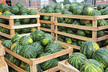
Chilean cherry prices continued to trend downward this week. The main varieties currently available in the market are Kordia and Regina, with smaller volumes of Lapins and Sweetheart. Prices for many batches have fallen by approximately 20% compared with last week. At present, the reference price for a Regina 2-in-1 pack (2J) is around ¥200 per box (approximately US$28 per box), while a 2.5 kg Kordia pack (2J) is priced at approximately ¥125 per box (around US$17 per box). Actual transaction prices vary depending on brand and fruit quality.
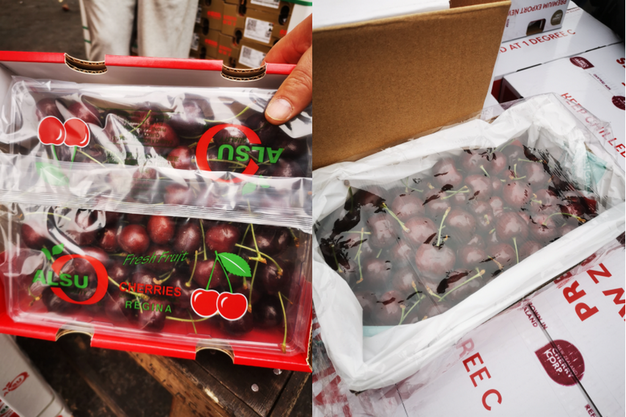 Left: Chilean cherries; Right: New Zealand cherries
Some traders noted that the proportion of high-quality cherries in recent arrivals has been relatively low. Coupled with sluggish retail sales, this has contributed to continued price declines. Other merchants reported that overall quality this season is not as strong as last year, with certain batches lacking firmness. With the pre–Chinese New Year purchasing peak still some time away, market trading activity remains slow.
New Zealand cherries are available in limited quantities, with 2 kg packs (3J) offered at a reference price of approximately ¥350 per box (around US$49 per box). Australian cherries are also arriving in small volumes, and traders report inconsistent quality. High-quality batches are priced higher and sell quickly, while lower-quality fruit moves more slowly.
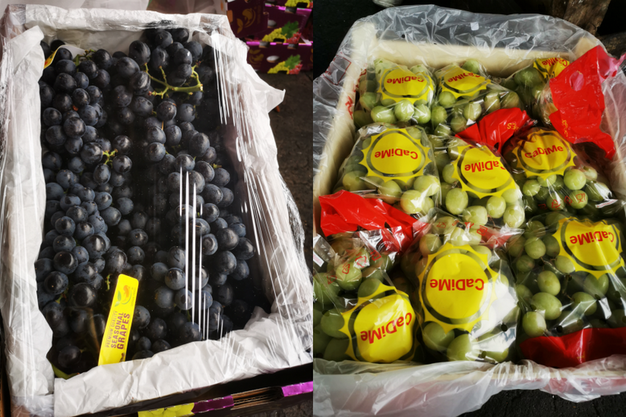 Left: Chilean Black Muscat grapes; Right: Peruvian Autumn Crisp green grapes
Prices for imported green grapes have dropped significantly compared with last week. For example, a 7.3 kg box of Autumncrisp® grapes is currently priced at approximately ¥360–390 per box (around US$50–54 per box), depending on size, representing a decline of 15–20% week on week. Traders indicated that slow sales have prompted widespread price reductions. Chilean Black Muscat grapes are also on the market, with 3 kg packs priced at around ¥190 per box (approximately US$26 per box), lower than during the same period last year.
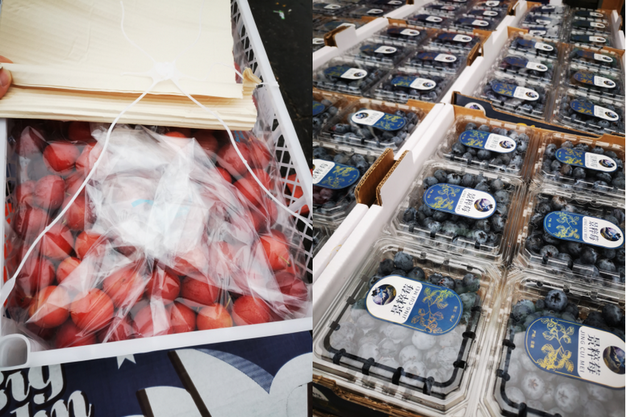
Left: Chilean plums; Right: Chinese blueberries
Blueberries, by contrast, are selling well due to limited overall supply, resulting in rising prices. According to traders, Peruvian blueberry prices have increased by about 20% from last week, with some premium brands selling at approximately ¥120–140 per box (around US$17–19 per box). Chilean blueberries are priced around ¥80–90 per box (approximately US$11–13 per box), up sharply from ¥50–60 per box (around US$7–8 per box) during the same period last year. Yunnan blueberries were priced at ¥140–145 per box (around US$19–20 per box) in the first half of the week, but eased to ¥130–135 per box (approximately US$18–19 per box) in the latter half as supply increased. Traders explained that in previous years, imported blueberries dominated the market at this time, while the domestic supply was relatively limited. This season, however, imported volumes are lower and domestic supply is comparatively higher, resulting in a pricing pattern that differs from past years.
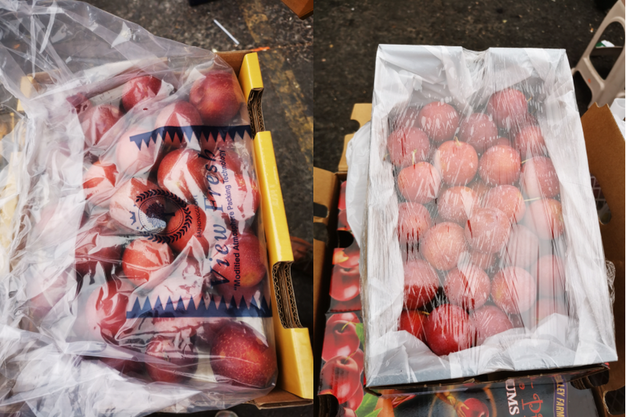 Left: Chilean cherry plums; Right: Australian cherry plums
In the imported stone fruit segment, small quantities of cherry plums from both Australia and Chile are available. Traders handling Chilean cherry plums reported that current prices are lower than in previous years, while arrivals and sales remain relatively smooth. The supply and sales performance of Chilean white nectarines are largely unchanged from last week, with current arrival volumes remaining limited.