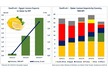
Mexico remains the world's second-largest lemon producer, with over 3.2 million tons annually. This citrus is essential to both daily diets and the country's agri-food system. Data from the Agri-Food and Fisheries Information Service (SIAP) shows that in 2024, national production reached 3,275,291 tons from an area of 214,467 hectares across 28 states.
Production is concentrated primarily in Michoacán, which accounts for just over one million tons. Veracruz follows it with 866,862 tons, Colima with 315,562 tons, Oaxaca with 310,220 tons, and Tamaulipas with 113,884 tons. This output supports high domestic consumption, averaging 19.5 kilograms per person annually, driven by the widespread use of lemons in Mexican cuisine, which adds flavor to snacks, broths, drinks, and desserts. Additionally, lemons are vital to the food and processing industries, where they are used to make juices, sauces, jellies, and sweets.
In this productive context, the federal government recently announced new measures to support the sector. During the morning conference on November 9, 2025, the Secretary of Agriculture, Julio Berdegué, reported on efforts to increase agricultural productivity in Michoacán through a strategy targeting producers of lemons, mangoes, sugarcane, avocados, and berries. The plan includes a public investment of 292 million pesos, complemented by credits totaling 1,509 million pesos, targeting approximately 10,000 production units. Key actions include technical assistance and health measures to improve crop yields and sustainability.
In addition, authorities have established a dedicated security system for the production zones. The Secretary of National Defense, Ricardo Trevilla, explained that the Paricutín Operations Plan includes deploying 860 military personnel to safeguard the lemon-growing, cutting, and packing areas in Michoacán. This operation is part of a broader strategy to combat crimes such as extortion, which frequently affect key agricultural regions.
Domestic production largely meets the national market demand, and Mexican lemons have a strong presence in international markets. The United States, the United Kingdom, and the Netherlands are key export destinations, boosting the product's role in the global agri-food trade.
Source: meridiano.mx