South Africa achieved a 28% YoY increase in its agricultural exports resulting in a trade surplus of US$2.7 billion, head of the Agbiz Fruit Desk Wolfe Braude shared with the media this morning. Growth in import demand has been very beneficial to South Africa and he reckons that the country's sophisticated agriservices sector ought to be better represented in the export column. "We're strong in agriservices. We'd otherwise not be the world's largest macadamia exporter, the largest chicory exporter and the second largest citrus exporter if we did not have a fantastic ecosystem," Braude remarked.
When advising government on policy planning, Braude says he likes to remind officials that the value of agricultural exports are slightly larger than the automotive and allied industries, twice the value of South Africa's iron ore exports and three times its chromium ore exports.
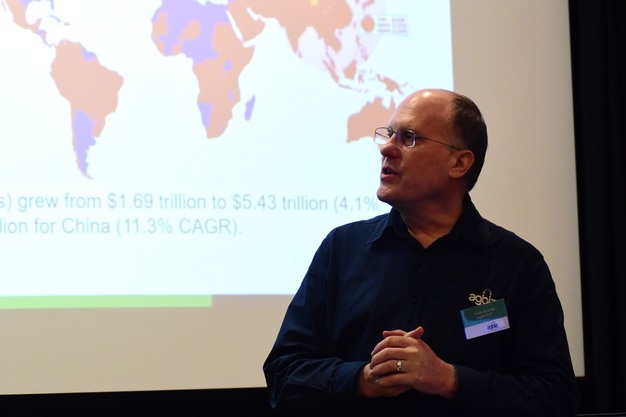 © Carolize Jansen | FreshPlaza.com Wolfe Braude, head of the Agbiz Fruit Desk
Govt commits to more outwardlooking stance
"We are in a time of choices. We are now in a season of diversification and what is our response?" Brade asked. "We must ensure that we're well-placed with a number of partners. We only have agreements signed with African partners, the Southern African Customs Union and the African Continental Free Trade Agreement (which is actually going quite smoothly), the EU and the UK. As soon as you move to the Middle East and Asia we have no signed, legally binding free trade agreements complete with mediation clauses and dispute arrangements that runs to an inch thick."
The citrus black spot débâcle in Europe, he observed, has shown the value of a challenge mechanism built into the Economic Partnership Agreement which South Africa shares with the European Union.
With the rest of the world, taking at least a third of South African fruit, trade is ruled by SPS protocols or bilateral access negotiated on a product-by-product basis, while "our competitors have trade agreements."
After years of Treasury budget cuts, South Africa's trade machinery needs to be rebuilt. "You could probably double the number of trade negotiators at the Department of Trade and Industry and still not have enough," he maintains. The importance of phytosanitary protocols demands that plant health posts be filled.
Braude showed some of the high tariffs applicable to South African fruit: India's 50% on South African apples and 30% on pears and oranges; China, the world's largest grape producer, has a 40% tariff on South Africa's grapes and no tariff below 10% on any other fruit. Russia's tariffs on South African fruit are much lower: 5% on apples, 4% on lemons and nothing on grapes.
"Now South Africa is looking more outwards. The government of national unity has committed itself to an external pivot," he said.
AGOA: "We live in hope"
In 2024 the distribution of South Africa's fruit exports was still dominated by the EU accounting for 36% of the market share which, when the UK is added, is 49%. Asia drew 17% of the fruit in that year, the Middle East 15% and trailing behind were North American (7%) and Africa (5%).
"If you add the Middle East and Asia, it [South African fruit] is about 1% of what they import," he noted. "The numbers are massive. We could expand our agricultural exports and still only be touching the surface in terms of these regions. Demand is not the issue."
The dilemma for trade negotiators is that markets with big potential for agricultural exports, can spell trouble to local textile and manufacturing sectors. Trade negotiations with China seem to indicate that the country will require greater access to South Africa's market, as the EU does through EPA. "For agriculture it's not a problem, we can take it, but for many sectors that's an issue."
There are "talks about talks" with India, while a resuscitation of the African Growth and Opportunity Act is on the cards, with a renewal coming from Washington perhaps this year still. Braude advised that South Africa could still be removed from the list of beneficiaries in a future review: there have already been three such attempts, all unsuccessful, in the US Congress he said. "Regarding AGOA, we live in hope."
 For more information:
Wolfe Braude
Agbiz
Email: [email protected]
https://agbiz.co.za/