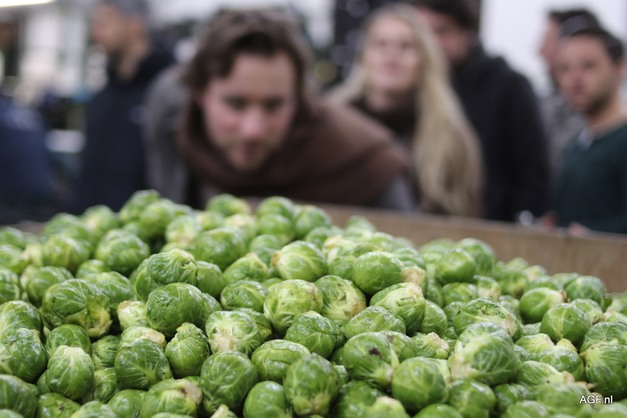
At Polderland Groenten in Heinenoord, everything revolves around sprouts. Everywhere you look, you see nothing but sprouts, big and small, in nets, plastic flow packs, and crates. During a tour of the farm for about 30 journalists from Fresh Publishers, who write for AGF, GroentenNieuws, BP Nieuws, FreshPlaza, FloralDaily, Hortidaily, MMJDaily, and Vertical Farm Daily, Corstiaan Piek takes his guests into a world where the smell of freshly harvested sprouts is omnipresent. Forklifts drive back and forth, employees stand bent over sorting lines, and pallets full of packed sprouts are wheeled into conditioned storage areas. The company is visibly running at full speed.
 © Martijn van Nijnatten | FreshPlaza.com
The specialist in growing and packing sprouts is experiencing an exceptional year. "We have an exceptionally high yield. Whereas in other years we could harvest around 22 to 24 tons per hectare, this year it is 30 to 35 tons per hectare." But according to Corstiaan, that is not necessarily favourable. "We have a lot of product, but because of that, prices are very bad," he explains. And he adds that this problem, low prices due to high yields, is not limited to his farm. For all outdoor crops, a glut on the market is causing prices to fall.
"Fortunately, everything that needs to be harvested is out in the fields, and with different weather, the tide can soon turn," Corstiaan expects. "At temperatures below zero degrees, harvesting stops, and then stocks disappear very quickly, and there is panic. That would help resolve this season's low prices."
Everything is growing better than normal
There are several reasons for the higher production. Despite the dry summer, Corstiaan says the soil is in excellent condition. "The soil is very healthy, everything is growing much better than normal." When asked whether new sprout varieties also play a role in this, he replies that the influence is limited. "Developing a sprout variety takes seven to eight years. That is not something that changes much from one year to the next," he explains.
 © Martijn van Nijnatten | FreshPlaza.com
Polderland Groenten grows some of the sprouts itself, but also works with around 12 growers with whom a close relationship has been built. The entire crop of these growers is purchased by Corstiaan's company every year. In Heinenoord, the sprouts are then packaged for sale throughout Europe and far beyond. "Everything goes through exporters and wholesalers; we have been doing it that way for years," Corstiaan says. "We have no ambition to do it ourselves. We are proud of our customers and respect the customer of the customer."
German consumer is decisive
About 70 per cent of production is destined for export to Germany. This is followed by the Netherlands, with Italy, France, and Eastern European countries at some distance. The German consumer is therefore decisive for Polderland Groenten.
Corstiaan explains that Polderland is expanding more and more in the north of the Netherlands. Not only because expansion in the south-western Netherlands is becoming difficult due to construction, but mainly because of a small but decisive difference in climate. "The temperature there is a few degrees lower," he explains. "Thanks to that lower temperature, we have less disease pressure in the north, and therefore we also need to use fewer plant protection products. The proximity to the sea, with cooling air and constant wind, also helps to reduce insect populations such as lice. The transport costs of all equipment and products are high, but that is outweighed by the reduced disease pressure."
This also prevents a problem further down the chain: lice on the sprouts. Washing the sprouts to remove them is not an option, according to Corstiaan. "Often the lice are between the leaves, and we want to keep the product as dry as possible."
Still sceptical about automatic harvesters
Although trials with automatic harvesters are underway, Corstiaan remains somewhat sceptical. "You cannot harvest everything with a machine. You also need employees for the work that a machine cannot do." Moreover, he wants to invest in staff retention. "You have to be able to give your people the enjoyable tasks too, not just the work a machine cannot do." At the same time, high labour costs weigh heavily on the company. "Retaining staff and keeping labour costs affordable is an increasing challenge," says Corstiaan.
 © Martijn van Nijnatten | FreshPlaza.com
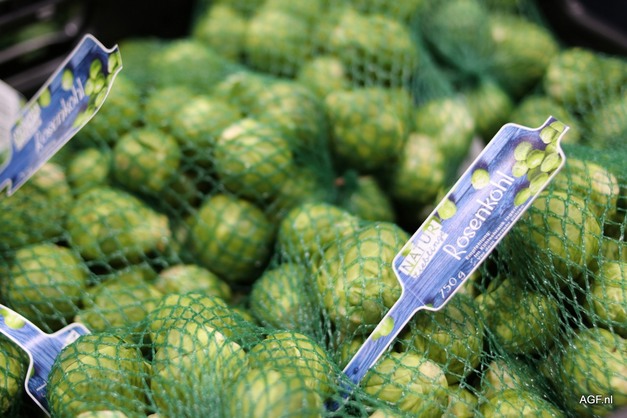
During the tour, it becomes clear that you can immediately see which sprouts are intended for which market. You can tell, among other things, by how the sprouts are packaged. In the Netherlands, consumers opt for airtight plastic packaging, the so-called flow pack, mainly because it ensures a longer shelf life. Germany, on the other hand, is moving towards using less and less plastic and prefers sprouts in netlon nets.
Small but nice, or big is nice, and lots is nice?
Size preference also varies by country. Dutch consumers prefer small sprouts, small but fine, because they feel that smaller sprouts have more flavour. "And they really do," Corstiaan reveals. German consumers go for large sprouts, following the belief that big is beautiful and lots is tasty. "Besides, cleaning a pan full of those big sprouts takes just a little less time," Corstiaan says with a smile.
 © Martijn van Nijnatten | FreshPlaza.com
Anyone entering the production hall for the first time is immediately greeted by the unique aroma of sprouts. This very recognisable smell hangs throughout the premises, but the strange thing is: after a while, you do not notice it anymore. You get used to it. And as one colleague remarked, it is a remarkable sight: "Everywhere you look, you see sprouts. Only sprouts! That is really special to see."
Sorting with AI
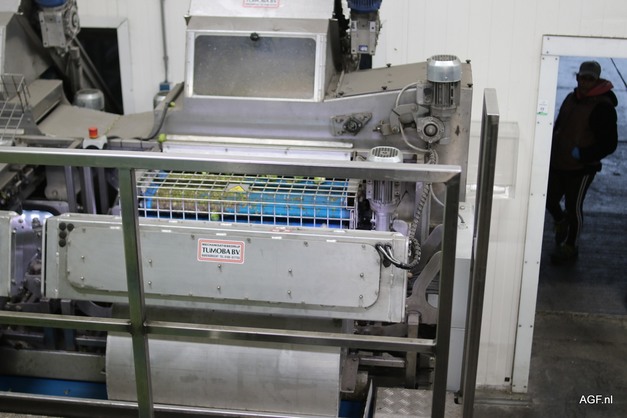
In the hall, there is a constant flow of trucks delivering freshly harvested sprouts. The green mini cabbages are unloaded automatically by machine. An optical sorting machine from Tumoba, using AI, separates the sprouts suitable for consumption from those rejected and destined for cattle feed. Corstiaan is very pleased with it. "It is the best investment I have ever made!" he says emphatically.
 © Martijn van Nijnatten | FreshPlaza.com
The sprouts are then sorted by size using a type of sieve with holes of different diameters. Employees then check the quality by eye before the sprouts go to the packing hall.
Exotic places
Once packed, the sprouts go into conditioned storage rooms. These are kept at a constant temperature of 2 degrees Celsius, Corstiaan explains. The crates, boxes, and Styrofoam packaging bear addresses from all over the world. Although Germany and the Netherlands are the main markets, Polderland's sprouts also literally travel to the other side of the world. While one pallet has an address that is, globally speaking, just around the corner, there are also pallets destined for exotic places like Singapore, Dubai, and Tokyo, as well as the United States.
Meanwhile, a colleague secretly grabs a sprout straight from the conveyor belt and eats it raw. "It was such a nice, tender little one. Delicious, man!" he later confesses. Corstiaan hears it and smiles.
My son eats more of them than I do!
When asked if he sometimes eats sprouts himself, Corstiaan answers with a resounding yes. "I eat Brussels sprouts at least once every fortnight. They are incredibly tasty and very healthy," he says. And for those who think children do not like Brussels sprouts, his two-year-old son proves otherwise. "He pokes one after another on his fork and eats them in no time. He even eats more of them than I do!" he laughs.
According to him, the taste of sprouts has improved over the years. The bitterness of the past has largely been bred out. But the preparation method has also changed in recent decades. Cooking for less time and stir-frying more often helps preserve colour, flavour, and texture. "And it is healthier too," says Corstiaan.
Message to The Hague and Brussels
Brussels sprouts are a relatively small market globally, with only about 20,000 hectares of sprouts grown worldwide, Corstiaan notes. "But it is a stable market," he says. To keep the sprout market stable in the future as well, he has one message for The Hague and Brussels: "Keep the laws and regulations on plant protection products workable. Everything that awaits us now makes us uncertain and unmotivated. It would be a shame if this sector is destroyed by the governments in The Hague and Brussels."
View the full photo report here
For more information:
Polderland Groenten  Zomerlandseweg 1
3274 LX Heinenoord
Tel: +31(0)186 600474
[email protected]