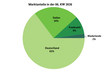
Despite a 33.36% decrease in sales to the EU market over the past decade, Spain remained the leading melon supplier in the European Union (EU) during the 2024/2025 season, according to a Hortoinfo report based on data from Eurostat, the European Communities' Integrated Tariff (TARIC), under code 080719.
Overall, EU countries' melon imports have dropped by 21.79% over the past ten years. Imports from Costa Rica (-58.28%), Honduras (-39.09%), Spain (-33.36%), and France (-28.95%) have declined significantly. Meanwhile, imports from Senegal (+77.98%), Italy (+15.95%), Morocco (+2.48%), and Germany (+1.27%) have increased.
During the 2024/2025 season, from September 1, 2024, to August 31, 2025, the EU imported a total of 787.55 million kilograms of melon, valued at 850.63 million euros. This results in an average price of 1.08 euros per kilogram.
Spain remains the EU's top melon supplier, with 253.42 million kilos sold, accounting for 32.18% of total sales. This amount reflects a 33.36% decrease from ten years prior. Spanish exports generated 266.18 million euros, with an average price of 1.05 euros per kilo.
Brazil ranked second, with 187.01 million kilos (23.75% of the total), worth 162.46 million euros, with an average price of 0.87 euros per kilo. Over the past decade, Brazilian sales to the EU have fallen by 11.59%.
The Netherlands ranked third, with 103.73 million kilos sold (13.17% of the total), valued at 139.36 million euros, and an average price of 1.34 euros per kilo. This reflects a 12.6% decline over the past ten years.
Morocco ranked fourth, exporting 46.92 million kilos valued at 63.46 million euros, with an average price of 1.35 euros per kilo, indicating a 2.48% rise in volume sold.
Italy closes the top five, with 35.73 million kilos sold in the EU, valued at 39.77 million euros, and an average price of 1.11 euros per kilo, up 15.95% compared to the 2014/2015 season.
Source: hortoinfo.es