Brazil's 2025–26 orange crop is developing under weather-related challenges and continued pressure from citrus greening disease. While output is projected to rise year-on-year, this follows a low production base in 2024–25. Fundecitrus revised its crop forecast downward in September, and industry participants expect another reduction in December. Despite these supply constraints, demand remains soft, and prices for orange concentrate continue to trend downward.
Citrus greening disease remains a central issue for global citrus production. Florida's industry has seen its growing area fall to about one-third of its size two decades ago due to greening and hurricane impacts. In Brazil, Fundecitrus reports that about 40 per cent of the 2025–26 crop has been affected by greening. The organisation noted that "greening severely compromises the productivity and longevity of orchards". The season has also seen rainfall levels around 70 per cent below expectations.
 © Mintec/Expana
Fundecitrus initially projected the 2025–26 crop in the São Paulo and Minas Gerais citrus belt at 314.6 million boxes. The forecast was reduced in September to 306.7 million boxes. Some market participants expect a further downward adjustment in December, potentially below 300 million boxes, which Fundecitrus classifies as a small crop.
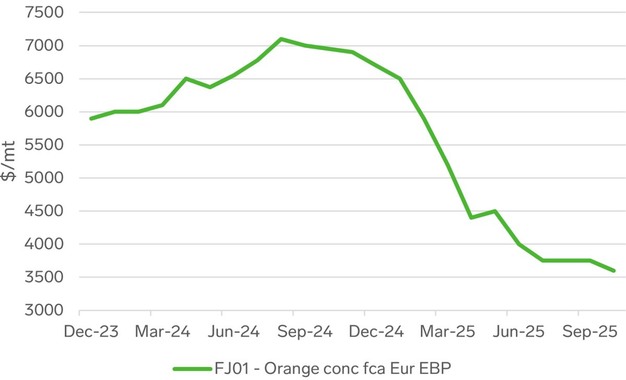
Despite these constraints, the orange juice sector continues to face reduced consumer demand. After the tight supply of 2024, orange concentrate prices rose sharply and peaked in August 2024. Elevated retail prices encouraged consumers to shift to alternative products. Concentrate prices then declined through 2025, but retailers did not adjust shelf prices. Interest has yet to recover, and market sources report that retailers are now using promotions to stimulate sales.
In October, Expana Benchmark Prices for orange concentrate FCA Europe were reported at US$3,600 per metric ton, down 4 per cent month-on-month and 48.2 per cent year-on-year. Sources indicate that supply for the current season is adequate. Some producers, particularly small and medium-sized operators, are accepting lower prices to maintain cash flow. Industry sources expect the sector to watch whether retail marketing efforts can rebuild demand pressure in the coming months.
Source: Mintec/Expana