EU citrus imports at the start of the 2025–2026 season show a mixed picture across categories, according to Eurostat Comext data updated on November 5, 2025. While some citrus types began the season above last year's levels, others recorded lower early volumes.
 © European Commission
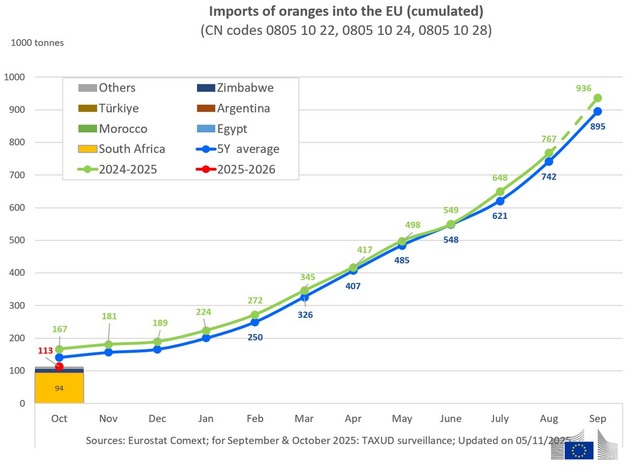
Orange imports into the EU reached 113.146 tons in October 2025, compared with 166,825 tons in October 2024. This marks a slower start to the season, as 2024–2025 volumes had already exceeded the five-year average at the same point. South Africa remained the leading supplier, with smaller contributions from Egypt, Morocco, Argentina, and Türkiye.
 © European Commission
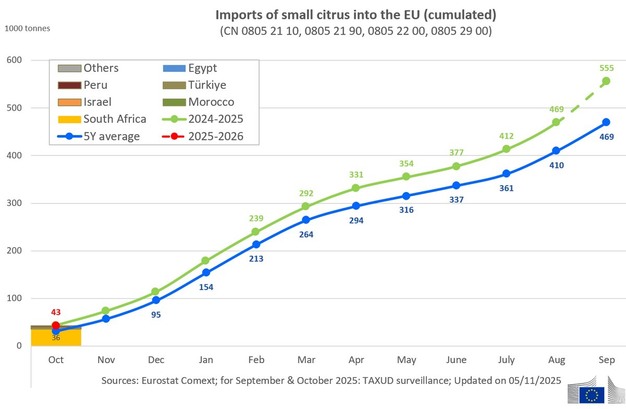
Small citrus imports totalled 42,651 tons in October 2025, up from 43,453 tons in October 2024. The category, which includes mandarins, clementines, and similar fruit, opened slightly above the five-year average. South Africa again accounted for the majority of early-season shipments, followed by Morocco, Türkiye, and Israel.
 © European Commission
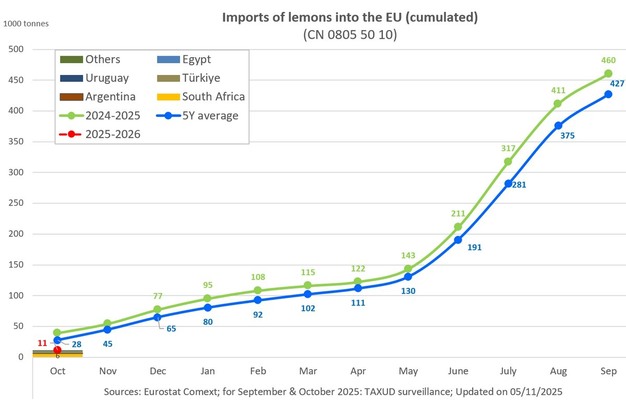
EU lemon imports were recorded at 11,130 tons in October 2025, compared with 38,727 tons in October 2024. This represents a notably lower start than both the previous season and the five-year average of 45,000 tons for the same period. The main suppliers included Türkiye, Argentina, South Africa, and Egypt.
 © European Commission
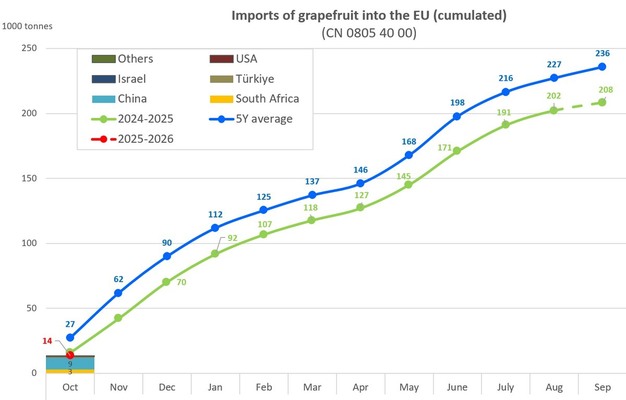
Grapefruit imports reached 13,507 tons in October 2025, compared with 15,978 tons in October 2024. Early-season supply was below the five-year average of 27,236 tons, with South Africa, Türkiye, China, and the United States as primary sources. Overall, early citrus import data suggests a slower entry into the European market compared with 2024, particularly for oranges, lemons, and grapefruit.
To view the full report, click here.
For more information:
European Commission
Tel: +32 2 299 96 96
www.agriculture.ec.europa.eu.gov