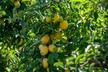
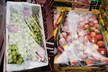
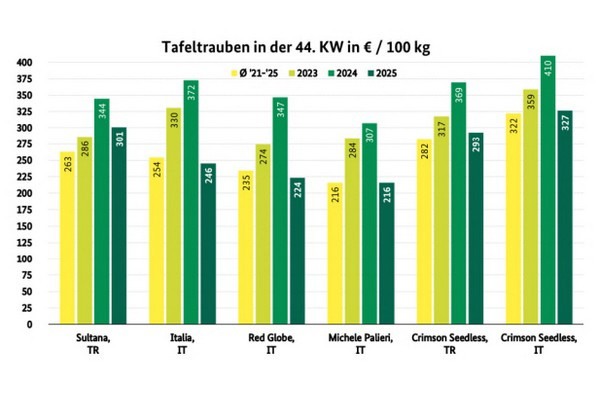
Italian grapes dominated the market: a wide variety of grapes were available, primarily Italia and Red Globe, but also some Arra and IFG varieties. In Frankfurt, quality had improved noticeably compared to the previous week, causing prices to rise. Customers in Hamburg also had to dig a little deeper into their pockets. Munich reported falling prices for Michele Palieri and Italia. According to the German BLE, Turkish Sultana grapes sold briskly in Southern Germany, but in Frankfurt, they failed to fully convince in terms of their organoleptic properties. 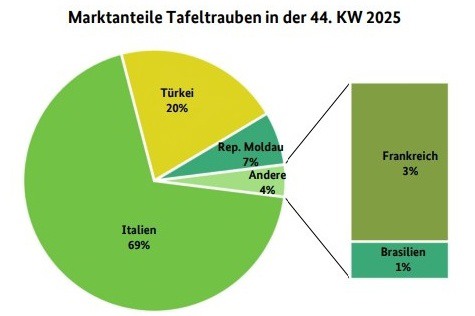 © BLE
© BLE
France contributed a small quantity of Alphonse Lavallée grapes, which cost €3.75 per kg in Hamburg. Moldova arrived from the Republic of Moldova but generated little demand and therefore sold slowly. The first Autumn Crisp from Brazil opened the season for overseas fruit in Munich.
Click here for the full market and price report.
 © BLE
© BLE
Apples
Demand was quite favorable in the autumnal weather. As a result of the expanded supply, retailers were not always able to avoid discounts.
Pears
Customers focused on domestic and Dutch loads. Demand was quite appealing, and business was quiet.
Small citrus fruits
Satsumas and clementines were primarily available from Spain, followed by Italy. The organoleptic properties of Spanish fruit had clearly improved; the items were offered in many different packaging units.
Lemons
While Spanish deliveries expanded massively, the presence of South African loads decreased enormously.
Bananas
Demand was fairly quiet across the board. However, supply was mostly adequately adjusted to the reduced storage capacity.
Cauliflower
Domestic loads predominated over Belgian ones. The German season was entering its final stages, which was already noticeable in some places in the form of declining quality.
Lettuce
The presence of domestic and Belgian loads decreased, while the presence of Italian loads increased. Customers focused on greenhouse produce from Belgium.
Cucumbers
Spanish supplies dominated over Belgian supplies for cucumbers. Marketing was quiet, so prices did not change significantly.
Tomatoes
Belgian deliveries outnumbered Dutch ones. Overall, supply and demand were sufficiently in balance, so there were no major price fluctuations.
Bell peppers
Spanish deliveries dominated. The quality of Dutch products was no longer consistently impressive, which is why their price range widened in both directions.
Source: BLE