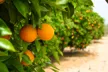
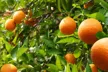
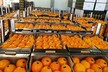
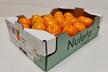
This year's clementine campaign in Piana di Sibari is characterised by a drop in production compared to the previous year due to the spring weather compromising part of the setting. Despite the lower supply, prices remain stable at last year's levels. Two crucial challenges for the sector are emerging: The strategic need to invest in late varieties in order to compete with Spain, and the urgent need to educate consumers to recognise the intrinsic quality of the fruits beyond their external appearance, i.e., the colouring of the skin, as it is being increasingly affected by the abnormal temperatures.
 © Maria Luigia Brusco | FreshPlaza.com"There has been a general decrease in production estimated at between 15 and 20% compared to the previous campaign," says Nicola Cilento (opposite), president of the COAB PO based in Corigliano-Rossano, in the province of Cosenza. "The main cause is the unstable spring weather, characterised by temperature drops during the flowering phase, which compromised the first setting. The intrinsic quality of the product is normal, as it has reached the Brix level required for marketing, and there is a prevalence of smaller grades."
The PO is currently between early varieties such as Spinoso and Clementina Comune, which are the most popular with consumers. The season is expected to continue until late December-early January, and then it will be time for the late varieties, for which COAB has invested in reconversions in order to extend their presence on the market until February.
The weather emerges as the most critical variable of the campaign. "After a brief hint of autumn in October, temperatures returned to spring levels, reaching 25-26 °C during the day. The current temperature range (15-25 °C) is significantly higher than the ideal range for clementines (10-18 °C)."
This "climatic schizophrenia", as Cilento calls it, causes several problems. "Among these is the skin, which struggles to achieve the deep orange colour that is stimulated by the temperature range between day and night. In addition, the high temperatures in the consumption areas in both Calabria and central-northern Italy, which remains our target market, discourage the purchase of citrus fruits, which are typically associated with cold weather, thereby causing a slight drop in consumption."
Educating consumers
"A central issue emerges that can no longer be postponed: that of educating consumers about their purchases. Due to global warming, it is increasingly common for clementines, especially early ones, to reach internal ripeness (sugar content, juiciness) without the skin having reached a uniform colour. It is essential to communicate to consumers that the fruits with green hues are not unripe; they are still a high-quality product whose appearance is simply a reflection of climate change."
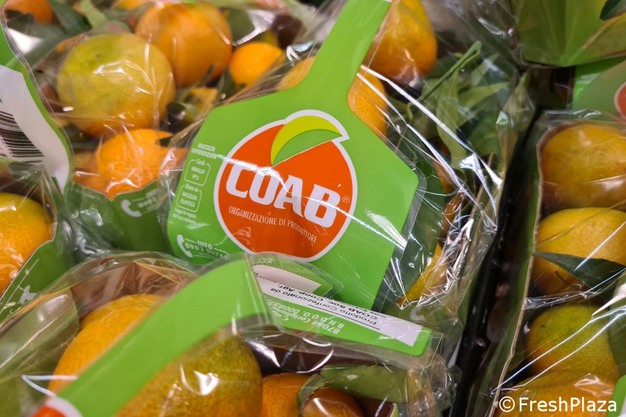
Despite the drop in supply, prices have not risen as much as hoped. The president of Op COAB confirms that prices are in line with those of the previous year. "The hope is that, with the arrival of the Christmas period - which is traditionally the period of highest consumption - there will be greater economic satisfaction for producers."
The Op designs about 90% of its production for the Italian market, strongly defending this share. "There are loyal consumers who appreciate Italian products and are willing to pay a premium for superior quality. Italian big retail chains (GDO) represent our main outlet channel due to the seriousness of the contractual relationships and the direct access to a wide audience of conscious consumers."
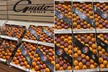
Over 35 years, COAB has made investments to meet the needs of the big retail chains. "We have equipped ourselves with state-of-the-art machinery and processing lines to speed up packaging and increase the quantity of product processed per hour. The goal is to always guarantee the freshness, quality, wholesomeness, and traceability of the product, while also processing large orders in a short time."
The foreign market (10% of the turnover) is considered complex and less profitable. "Spain represents our main competitor outside the national borders. Due to economies of scale and higher production volumes, Spanish companies can offer lower prices with which makes it difficult to compete. Spain is particularly strong in the late segment (February-March) in Italy as well. Therefore, it is necessary for our country and for Calabria in particular - given that the region produces 2/3 of all Italian clementines - to speed up varietal reconversions to cover this period and not leave market space to competitors."
 © COAB
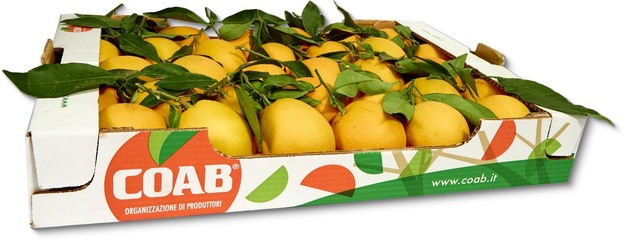
In addition to clementines, COAB has also successfully launched the Navelina orange campaign. "We are in the process of harvesting and packing this blond citrus fruit. The variety is very popular with consumers and the big retail chains. This production also suffers from the issue of small grades due to the unstable spring weather."
 For more information:
COAB - Agricultural Cooperative Society
Contrada Scavolino - Frazione Cantinella
87064 Corigliano-Rossano (CS)
+39 0983 80740
[email protected]
www.coab.it