This year's weather conditions in Greece were very different from the previous one, but both years have come with its set of challenges. This year, a spring frost made the season much more difficult, says Vasilis Xekarfotakis, the finance and sales officer for Greek kiwi exporter Nespar:
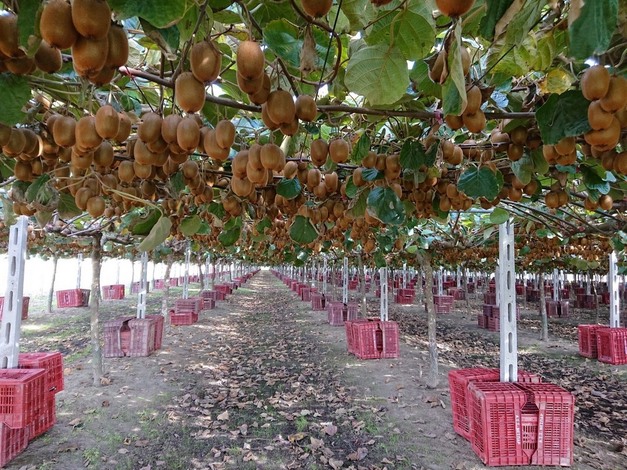
"The kiwi growing season was quite different from the previous one. While the summer was milder than the previous one in terms of temperatures, and the prolonged heat wave we experienced last year, this year's early spring frost in late April greatly affected production in our region. This has resulted in fruitlessness as well as poor fertilization, resulting in smaller and, in many cases, irregularly shaped fruit. These results are evident throughout the country, mainly in northern Greece, and specifically for our region around the Nestos River. Despite the losses that the farms have from the extreme weather phenomenon, with the new farms coming into production, the loss from the late frost at the end of April is being compensated."
 © Nespar
The kiwi harvest is still ongoing, but overall production should be similar for Nespar, perhaps slightly larger on a national level, Xekarfotakis explains. "We're still in the harvest stage, with about 10-15 days left, estimating to finish on November 10-15. Specifically, production levels for us as Nespar are expected to be the same as last year, approximately 5,000 tons, while overall production for Greece is expected to increase by 5 to 10 per cent. This is due to the new plantations that are constantly entering production, thus making up for the losses from the larger estates."
 © Nespar
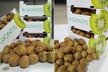
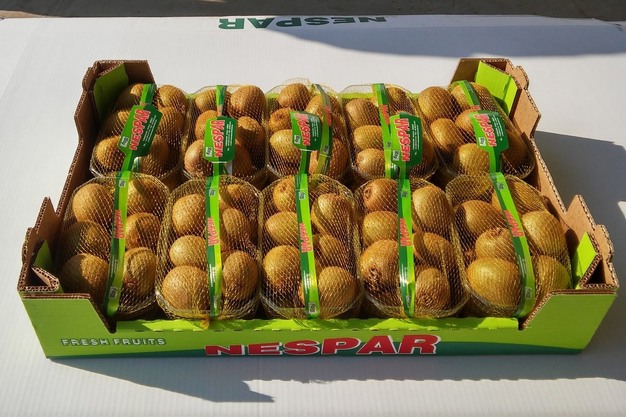
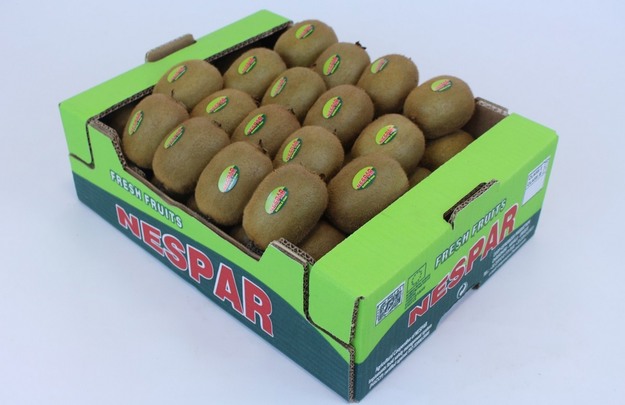
Xekarfotakis states that there have been many improvements in the company's practices that allow them to export to the most demanding markets: "As A.C. NESPAR, through specific practices and a strict protocol regarding production, but also within the packaging plant, we've managed to have a fruit that is capable of traveling and standing in the most demanding markets. Thus, the main target markets for us are North America and China, but also European markets and importers in general, that are aimed at a consumer audience willing to pay more in order to buy a premium and quality fruit."
"Although we expected the sizes to be at least one size smaller, as the harvest progresses, we notice that the sizes do not differ much from last year, thus increasing the expected average production per hectare," Xekarfotakis adds.
 © Nespar
All things considered, things are shaping up for a satisfying kiwi season in Greece: "In terms of prices, although it is still very early, it's expected to be a good year, with prices fluctuating at the same levels as last year. With larger sizes being the exception, as there are fewer of them, and as such, they can fetch a better price in the market. Overall, it is expected to be another good year for the Greek kiwi. With the investments and modernization that have been made in the country's packing plants in recent years, combined with the cultivation practices applied in the fields, Greece's position in the international kiwi market has increasingly strengthened," Xekarfotakis concludes.
For more information:
Vasilis Xekarfotakis
Nespar
Tel: +30 25910 61779
[email protected]
www.nespar.gr