One of the biggest challenges in mushroom production is finding and retaining (good) harvest workers. How AI can help minimize this problem was an exciting topic at the 77th annual conference of the BDC in Leipzig at the end of September. In addition, the potential use of AI in production was highlighted. "Welcome to the brave new world. There is still a lot to look forward to." With these words, Waldemar Schuler, the new chairman of the Bund Deutscher Champignon- und Kulturpilzanbauer (BDC) e. V. (en.: German Button and Cultivated Mushroom Growers Association), summarized the presentations on the use of artificial intelligence in mushroom production and harvesting. Stéphane Doutriaux from the Swiss company MycoSense SA/AG/Inc. (CH-Cully) presented the company's own products for determining the harvest time with the help of AI. Mark den Ouden from Mushroom Office / Mushroom Education Centre B.V. (NL- 's-Hertogenbosch) highlighted the possibilities that AI can offer in mushroom production in his presentation "Artificial Intelligence in Mushroom Cultivation." 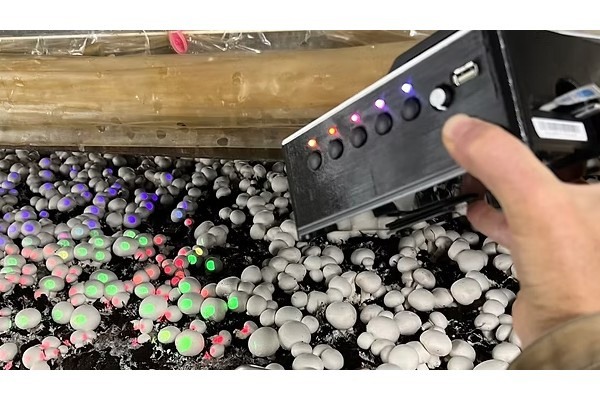 © MycoSense SA/AG/Inc.
Greater efficiency instead of more mechanization
Doutriaux made it clear right at the start of his presentation: "The goal is to make every employee more efficient during harvesting, not to mechanize harvesting more." Robots are not the answer to the question of how to increase picking performance. Over the past six years, MycoSense has visited over 50 different mushroom farms and analyzed their processes, infrastructure, and challenges. The result: almost all farms were different. "New technologies must fit into the existing infrastructure of the mushroom farm. And they must be introduced gradually," said the founder and CEO of the tech start-up. With its two key products, 'Spotlight' and the associated "Harvest Manager Software," MycoSense now provides mushroom producers with an effective solution for increasing efficiency.
AI-assisted harvesting with MycoSense Spotlight
MycoSense Spotlight is a portable, wireless device that detects mushrooms ready for harvesting on the bed. It can be attached to various trolleys and shelving systems and is currently available for Limbraco picking trolleys, GTL tilting shelves, and Growtime picking trolleys (Newton & Pascal). Depending on the picking instructions, Spotlight indicates the mushrooms to be picked with a green dot. Automatic speed control of the picking trolley enables continuous picking in several passes as well as stop-and-go for thinning dense beds. Harvesters do not need to adjust the speed or stops; the system stops automatically when changing the picking trays. This increases the yield and harvesting speed.
Spotlight can determine the number of mushrooms per generation and distinguish between generations, which maximizes the yield. The system measures with an accuracy of 2 mm, displaying only what the picker needs. The mushrooms are scanned in real time, and "Bid Data Maps" are created for decision-making. Information is available on the number of mushrooms per generation, the size distribution of the mushrooms, and the cluster density.
The Harvest Manager Dashboard
With the help of the Harvest Manager Dashboard, the software enables data-based decisions, better predictions, and the management of pickers (and teams). Using an app for mobile phones or tablets, producers can access the information on the go and quickly coordinate work and personnel. An RFID picker check-in system enables precise statistics to be compiled, for example, on the performance of individual employees or each individual's growth cycle. A room report records unusual events, such as diseases in the stock. "The AI needs to know everything to make realistic decisions," Doutriaux sums up.
Increase in picking performance
According to the expert, using the system over the past two years has increased picking performance by 3.5–10 kg/h, which corresponds to an increase of 10–30 percent. Yields increased by 2–6 percent. More uniform mushroom sizes in the trays, less over-picking, and a shorter training period for new pickers were also observed.
According to the CEO, the biggest challenges (still) include attaching Spotlight to the many different carts and trolleys and adapting to different strategies. Automated decision-making based on different pinning patterns and fleet management, especially for growing fleets, also requires further work. However, new features such as Speed Control have increased performance.
Digital data required
Doutriaux pointed out that for the system to function effectively, all data must be available in digital form. "You can't benefit from AI unless everything comes together somewhere," he said in Leipzig. MycoSense supports its customers in achieving this and is investigating how its proprietary software can best be integrated into the existing IT systems of individual companies.
Use of AI in mushroom production
Mark den Ouden from Mushroom Office / Mushroom Education Centre B.V. is pursuing another exciting approach to the use of AI. The starting point for his research was the question "Can you do anything with images and AI in mushroom cultivation?" Together with Emile Derache from the Belgian company Heliovision (B-Leuven), he is working on using AI in production to make statements about mushroom growth. Heliovision specializes in image processing solutions based on 2D and 3D imaging. Specially developed software uses intelligent algorithms and deep learning technology to recognize and analyze mushroom growth, enabling processes to be automated and tailored to the customer's needs.
Observation of fungal mycelium growth
"Button mushroom cultivation requires great effort; it has to be checked several times a day," said den Ouden, describing the work of the producers. "And that's seven days a week, 365 days a year, twice a day, every day, year after year. When do I have to start aerating, counting buds, and what is growing and what is not?" Observing mycelium growth was therefore the focus of the research to be able to make predictions about these questions with the help of AI. According to Ouden, we are "now at a point where the technology is becoming cheaper and it is worth it."
A camera is used to photograph the casing soil from above every hour. AI evaluates the images and is supposed to find answers. How white does the casing soil need to be to determine the optimal time for aeration? This has an impact on the number of mushrooms and the start of the harvest. AI is used to count the number of buds that come through and to determine the different stages of growth. This allows producers to better plan their staffing requirements, harvesting, sales, and distribution.
The cameras are currently in use at three farms, with two more in the planning stage. Ouden cited improved yields as another advantage, which means less work for producers, lower harvesting costs, better staffing planning, and fewer errors in production overall—and thus greater job satisfaction and lower staff turnover.
Source: BDC
Further information:
https://www.mycosense.ch/