Inventing and developing new technology is exciting, but growers only truly benefit when they can successfully put those innovations into practice. That message came through loud and clear at the opening of Hortivec, a new demonstration, networking, and experience center for agricultural and horticultural technology in Sint-Katelijne-Waver, Belgium. One of the keynote speakers, Frits van Evert from Wageningen University & Research, focused on exactly that topic in his presentation titled "From Idea to Practice: Agricultural Robots in Action."
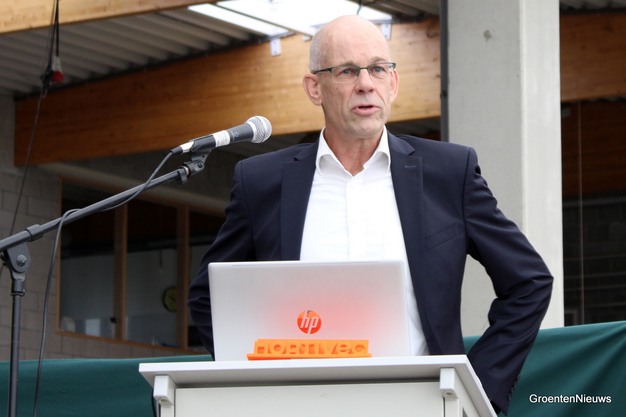 © Thijmen Tiersma | FreshPlaza.com
Keynote Frits van Evert at the opening of Hortivec
Frits shared insights from the Rob4Crops project, which explores how robotics can help tackle major challenges such as climate change and sustainable crop protection. These challenges are growing fast, he noted, yet robots are still a rare sight in most fields. That's why the Rob4Crops project was launched—to understand what's holding back wider adoption of robotics in agriculture, especially when the obstacles aren't always obvious.
Sensors and software
As part of the project, four large-scale pilot programs were carried out. Frits walked the audience through each one, supported by video footage. The pilots showed that getting robots to work smoothly in real-life farming conditions is no small task. Good sensors are essential to help robots navigate accurately in the field. "A robot alone won't get you very far," Frits pointed out. Alongside sensors, reliable control software is just as important to ensure that everything runs seamlessly.
The trials took place in France with table grapes, Spain with apples, Greece with table grapes again, and the Netherlands, where the focus was on sugar beet cultivation. In each case, the goal was to find robotic solutions for crop protection.
Learning lessons from practice
In France, the pilot was the most successful. Mechanical weeders tested there are now being used in real-life vineyards, reducing or even eliminating the need for herbicides. In Spain, where a tractor with a precision sprayer was trialed, Frits also expects promising practical results. The main hurdle, maintaining accurate driving even with a poor GPS signal, was overcome by adding complementary technologies like Lidar.
In Greece, things turned out differently. The combination of tractor and sprayer proved unsuitable for the local conditions because the sprayer was simply too heavy. As a result, the team shifted its focus toward developing autonomous tractor driving instead.
Back home in the Netherlands, Smart Agri Technology took part in the sugar beet pilot, aiming for robotic weed control. However, after the project ended, many growers still had doubts about its practicality, so it didn't lead to a direct application. Even so, the team didn't stop there; they successfully pivoted toward precision crop protection, and today, their spot sprayer is available on the market.
"I'm not handing out a recipe book," Frits said after a session full of real-world examples. Bringing a new technology to market remains a complex challenge with no universal formula. Still, the audience left with valuable insights from these open-field trials. Afterwards, during a tour through the Hortivec greenhouses and fields, visitors could meet various companies that are also working hard to bridge the gap between innovation and everyday horticultural practice.
Various videos of the Rob4Crops project are available online, including those discussed on Thursday.