As the owner of A. Mataw Impex, which exports fresh vegetables in and out of Suriname, and Chimady NV, specializing in frozen vegetables, he knows what is happening in the Surinamese fresh produce sector. Since 2011, he has been active in exports, initially with his own cultivation, but now purchasing vegetables from local growers. The primary destination for Adjai's vegetables is the Surinamese community in the Netherlands, Belgium, and the United Kingdom.
 © Pieter Boekhout | FreshPlaza.com
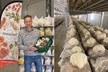
Adjai Mataw with frozen long beans
Small-scale local growers supply Adjai with the raw materials. "Almost no one has more than one hectare. Only rice is cultivated on a larger scale in Suriname." Most growers are over 45 and uneducated, while young people show little interest in agriculture or horticulture. "There is an urgent need for agricultural education to engage young people in an active role within the fresh produce industry," the exporter says. Without a new generation of growers, the system risks collapsing.
 © Pieter Boekhout | FreshPlaza.com
Missing link: Guidance and quality control
In addition, there is a structural lack of government support, especially regarding crop protection. "Growers must protect their crops against diseases and pests, but they are not properly informed about which effective products are approved for export. It is the government's responsibility, the Ministry of Agriculture and the plant health service NPPO, to guide on this," Adjai says. "Good practices start with cultivation, and we still have some catching up to do in that area."
 © Pieter Boekhout | FreshPlaza.comFrozen sehna
Another issue is sales. "Between 2019 and 2024, I exported five to eight containers annually with a range of 10 to 15 frozen vegetables, but this year I'm only at three. Each year is different." According to the exporter, this is partly due to changing consumer preferences. "The younger generation hardly knows traditional vegetables like bitter melon or antroewa anymore. Even in Suriname, vegetable consumption is declining."
 © Pieter Boekhout | FreshPlaza.com
Frozen bitter melon
However, there are bright spots. "Sehna sells well; I'm even the only supplier on the export market, so I have no competition. There is also potential in ready-made meals, which are popular in Europe. A mix of long beans with pre-cooked shrimp or bitter melon with chicken is a possibility."
 © Pieter Boekhout | FreshPlaza.com
Pre-cooked and frozen cassava
Price pressure and international competition
The export of frozen Surinamese vegetables is also hindered by pricing. "We have a high cost price in Suriname. Frozen cassava from India costs €2 for 5 kilos, and bitter melon from Vietnam only 50 cents per half kilo. We cannot compete with that," he laments. The Caribbean islands are also a difficult market. "They prefer to buy cheaply from Venezuela. And then there are the payment issues with some customers in the Caribbean; several times I've had no money credited to my account."
For fresh vegetables, logistics remains the biggest challenge. "Exporting to Amsterdam is possible; you just have to pay for the space. But I also want to reach England and Belgium. The Surinamese communities there are a good market, but there are no direct flights. Dutch exporters provide that service, but I would prefer to handle it myself directly."
 © Pieter Boekhout | FreshPlaza.comThe processing area meets hygiene standards
Stability and cooperation
What Adjai wants most, however, is stability. "If I know in advance that I can send seven containers of frozen vegetables each year, I can also manage the growers more effectively. The vegetables are there. It's the continuity of sales that has been lagging somewhat lately. We will work on that in the coming years."
For more information:
Adjai Mataw © Pieter Boekhout | FreshPlaza.com
A.Mataw Impex
Chimady NV
Welgedacht A weg 360
Lelydorp (Suriname)
Tel: +597 8778575
[email protected]
[email protected]