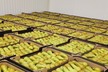
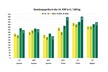
Apple production in Santa Catarina, Brazil, for the 2025/26 harvest is projected to reach 615,000 tons, an increase of 28% compared to last year. According to Epagri's Center for Socioeconomics and Agricultural Planning (Epagri/Cepa), this growth is driven by higher productivity, which is expected to reach 35,700 kg/ha, up 28.4%, despite a 0.3% reduction in cultivated area.
The Fuji variety remains dominant, representing 53.8% of the planted area and 51.2% of the production estimate. Gala follows with 44.3% of the area and 47.2% of production, while early apples account for 1.9% of the area and 1.6% of output. Regional distribution is concentrated in Campos de Lages, with 83.1% of total production, followed by Joaçaba at 11.2% and Curitibanos at 5.6%. Analysts note that with higher forecasted volumes, margins could improve, and prices may adjust downward in the domestic market.
The Epagri/Cepa estimates also cover beans and bananas. Productivity growth is expected across these crops, but analysts highlight the risk of lower prices due to higher domestic supply in the previous cycle.
Glaucia Padrão, analyst at Epagri/Cepa, stated that the fall in grain prices, resulting from increased domestic supply, requires caution. "The expectation is that market analysis and regional decisions will guide crop choices and allow for safer planning for the new harvest," she said.
Harvest estimates are compiled from data gathered in the state's main production regions by a network of collaborators, including Epagri extension agents, cooperatives, unions, municipalities, banks, and other rural institutions. After data collection, statistical analysis is applied to evaluate changes in planted area, production, and productivity, and to compare initial and final forecasts with previous harvests. Technical meetings with researchers monitoring each market are included to increase accuracy.
Santa Catarina remains a central producing region for apples in Brazil, with productivity and varietal distribution shaping both national supply and pricing outlooks for the coming season.
Source: Abrafrutas