Plastic packaging is still very much suitable for the fresh produce industry, as long as you're flexible to your clients' needs, says Sibel Abudaram, general manager of Turkish packaging manufacturer Asplastik: "We specialize in flexible packaging for the fresh produce industry, focusing particularly on fresh fruit and vegetables and plants. Our core production includes wicketed bags, macro- and micro-perforated bags, flowpack film on rolls, covers, and OPP, CPP & KRAFT conical bags. We design our packaging to ensure both product freshness and visual appeal, while maintaining efficiency on automatic packing lines."
According to Abudaram, their packaging is suitable for a lot of products. "Our packaging is mainly used for carrots, lettuce, herbs, snack tomatoes, radish, green onions, leeks, green beans, chicory, asparagus, peppers, apples, pears, mushrooms, and other fresh produce that requires ventilation and durability. This diversity allows us to adapt film properties to specific product requirements, balancing shelf life and sustainability."
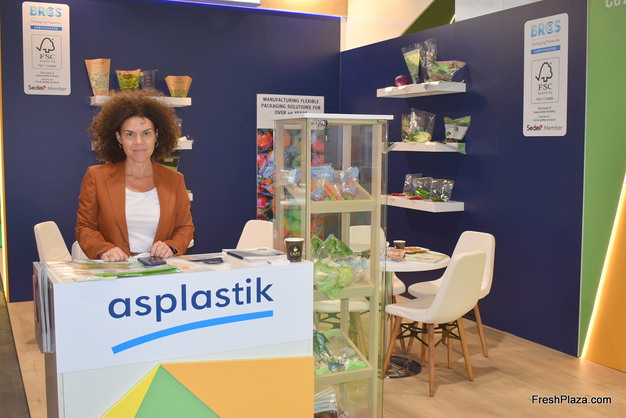 © Nick Peters | FreshPlaza.com
Sibel Abudaram, general manager of Asplastik
Wıthin the packaging industry, Abudaram sees that packaging with a lower environmental impact is more in demand: "There's a clear shift toward lightweight, recyclable monomaterial solutions. Customers are requesting thinner yet stronger films, with better machinability and reduced environmental impact. At the same time, we've seen increased demand for perforated and high-clarity packaging that enhances visibility and breathability, especially for fresh produce packed in high humidity conditions."
With this trend in mind, one might think getting rid of plastic altogether is the way forward. However, Abudaram states that plastic packaging has actually gotten back a lot of its previously lost popularity. "Many of our customers initially moved toward paper or compostable materials, but later returned to plastics, mainly due to food waste, shelf life, and sealing performance concerns. When designed properly, modern recyclable plastics actually offer a lower carbon footprint, thanks to their lightweight nature and recyclability within existing collection systems. We believe the future lies in recyclable and recycled plastics, not in eliminating plastics altogether. Plastic is fantastic as long as it is recycled."
The packaging that Asplastik creates is exported all over the European market, Abudaram explains: "We export to over twenty countries across Europe, including the Netherlands, France, Germany, Greece, Belgium, Austria, and the UK. Our packaging is widely used by packers and supermarkets that supply major retail chains. Currently, we are focusing on expanding further into Southern Europe and the Mediterranean region."
"We take great pride in combining sustainability, innovation, and service. Our BRCGS, FSC, and GRS & RCS certifications ensure full traceability and compliance with the highest standards. At the same time, we maintain flexibility as a family-run company with 40 years of experience. Our goal is simple: To make our customers' packaging both efficient and environmentally responsible," Abudaram concludes.
For more information:
Sibel Abudaram
Asplastik
Tel: +90 212 780 0355
[email protected]
www.asplastik.com.tr