The soft fruit division of Frankort & Koning has expanded rapidly over the past few years. "We sell strawberries all year round. Retail, catering, and wholesale customers are increasingly finding their way to us because of our service, flexibility, and product quality," begins Sjraar Hulsman.
 © Frankort & Koning B.V.
The trader is happy with how the winter season went. "Lit cultivation is gradually gaining ground, not only with clients in the Netherlands but overseas, too. More exclusive buyers in our non-Dutch markets want to continue in winter. They want the same type of produce that meets the same quality requirements and is in the same packaging, directly from our growers. We could, therefore, keep going well over the past few months. Everyone participated. That's partly because Spain had a lot of rain. That was desperately needed because it had been far too dry there, but it did cause some quality problems, so some customers switched to Dutch products earlier."
On the cultivation side, says Sjraar, lit cultivation has picked up well again after the energy crises. "Growers invested in energy-efficient LED lighting and are increasingly striving for more consistent production. On the one hand, to avoid peaks, price drops generally accompany them. On the other hand, they want a uniform workload so they can employ a permanent team and maximize their resources. Growing companies have to provide accommodation, another reason why year-round employment is desirable," he says.
"Also, when growers have to start with a new group of people every time, they have to teach them how to pick the products and what crop work needs to be done, especially in strawberry cultivation. That's very costly and time-consuming. The quality often reflects that. There's always someone who handles the product a little less gently. That consistency is being addressed by choosing varieties with a longer production period, which we then see back in both the winter and summer volumes."
Competition from Italy
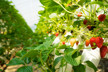
Yet, despite continuous trade, the 'true work' begins anew in mid-April, marketing-wise for strawberries. These, after all, remain a summer product par excellence. "Unlit cultivation has added great quality, and we've had wonderful weather, with cold nights and sunny days. That's ideal for strawberries. They set well, too, because the pollen is loose, and the bees are buzzing all around. That raises this fruit's Brix value, which improves its flavor, dry matter content, and firmness. Diseases such as fruit rot are also less likely to occur. So we certainly have no complaints, and with the sun comes demand. For the past few weeks, the German market, our largest one, has noticeably been turning to products from the Netherlands," Sjraar explains.
"Germany has greenhouse produce - very similar to Dutch produce - on the market, too. But, the asparagus harvest is slowly getting underway, and farm stalls often offer that alongside strawberries. That's where the high demand is originating." Will there be a complete switch to Dutch strawberries?" No, there's still competition from Spain, and Germany still has full-scale retail campaigns with that product. Questionably low price levels sometimes accompany that, but apparently, that's possible. Italy and Greece are also emerging as production areas. Italy, in particular, can compete with the Netherlands in terms of quality, so Italian strawberries are popular, especially in southern Germany. That makes competing in those areas difficult."
No more peaks
Price-wise, Sjraar is satisfied with how things have gone, but the arrival of large volumes has caused a slight dip. Nonetheless, according to him, that is of no concern. "From week 7 onwards, we had fairly high prices of €11 to €12 per kilo. When the first strawberries of the Inspire variety and Lady Emma from unlit cultivation arrived, prices fell somewhat to between €7 and €9, which is still satisfactory. Sonsation was added about three weeks ago, and Elsanta has recently returned to the market, putting more pressure on prices," he explains.
"We've, thus, dropped to €5 - €6/kg, but that's not unusual for this time of year. These are traditionally 'normal' levels. The market is, however, noticeably somewhat erratic. Prices at various auctions dropped in early April and again this week, but expectations for Easter are high and we're expecting another sales boost. After Easter, our strawberries will also be shipped in larger volumes to Scandinavia, the Baltic states, and later to the Mediterranean countries. We have a strong position there and are ready to go."
 © Frankort & Koning B.V.
"When it comes to choosing varieties, ever-bearers are garnishing more interest. Breeding is based on consistent production, flavor, shelf life, and minimal use of crop protection products. That means certain varieties are disappearing," says Hulsman. "A variety that was widely grown in the Netherlands, mainly because of demand from the English market, is now being phased out of greenhouse cultivation due to its susceptibility to root diseases. Growers tried to keep it going with chemical crop protection products."
"But that variety is now genuinely on its way out. No grower wants to use chemical crop protection products. And vigorous plants are vital. People want alternatives to crop protection products, like UV light, to combat mildew. The market demands it and growers want to find the best solution. Those alternatives are, thus, being explored to the fullest. I'd stake my reputation on it. That trend is set to continue, so we should see an increasing shift in varieties and alternative approaches to pest and disease control," Sjraar concludes.
This article was previously published in Primeur May 2025. Click here for the link to the entire edition
 Voor meer informatie:
Sjraar Hulsman
Frankort & Koning
Tel: +31 (0) 77-3897333
www.frankort.nl
[email protected]