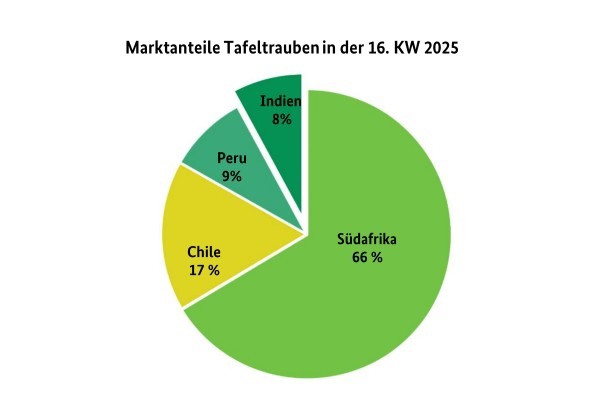
South African grapes, especially the red Crimson Seedless variety, dominated the German market. Shipments from Chile followed in terms of importance, with Peruvian and Indian loads mostly serving as supplements. Many varieties were available, which led to a fairly wide price range in some cases. The quality was not convincing everywhere: in Frankfurt, customers particularly criticized the quality of Chilean products. Interest was generally quite favorable and, overall, prices tended to rise. In Frankfurt, buyers had to dig deeper into their pockets, especially for South African loads. Prices rose, partly due to higher initial demands. In some places, returns from food retailers arrived, which, on the one hand, hampered sales of regular goods and, according to the BLE, on the other hand, could only be sold with difficulty due to declining organoleptic properties.
 © BLE
© BLE
Click here for the full market and price report
Apples
Dominant domestic products were flanked by Italian and French deliveries. Only very small quantities came from the Netherlands, Belgium, Poland, and Austria. In Berlin, there were also a few Chilean Royal Gala apples. The holiday season pushed demand down.
Pears
South African imports in the form of Cheeky, Packham's Triumph, and Abate Fetel dominated the market. Chile and Argentina were primarily involved in marketing Abate Fetel. The presence of Italian fruit was noticeably limited.
Strawberries
Dutch loads dominated, followed by Greek, Italian, and Spanish in terms of importance. Domestic quantities remained limited, with Belgian fruit only participating in the trade in some places. High-quality domestic fruit was particularly scarce and correspondingly expensive.
Lemons
The switch from Primofiori to higher-quality Verna continued for Spanish produce. Prices therefore, climbed upwards. In some places, Spanish loads were unrivalled, while Turkish loads were the main source of supply on some markets.
Bananas
Demand was noticeably limited as a result of the Easter holidays. Traders responded by reducing supply. This led to stable prices almost everywhere.
Cauliflowers
French and Italian loads clearly dominated. There were also a few Spanish products. The presence of German produce expanded, but volumes were still limited at the start of the season.
Lettuce
Belgian deliveries dominated the lettuce market. German and Italian supplies followed. Demand could not be fully satisfied in some places, which led to rising prices. The presence of mixed lettuce increased, with loads from Germany gaining in importance.
Cucumbers
The range of cucumbers consisted of Dutch, Belgian, and German loads, which accounted for roughly equal shares of the trade. Prices tended to fall, in some cases quite significantly.
Tomatoes
In the vine tomato segment, loads from the Netherlands, Belgium, and Spain dominated the market. Cherry tomatoes came mainly from Italy and the Netherlands, while beef tomatoes came from Belgium and the Netherlands. In general, there was a wide range of products available, and the supply had expanded.
Sweet peppers
The Spanish loads, which had previously set the tone, have now been replaced by Dutch loads at the top of the range. Belgian and Turkish products were also available. The few domestic products met with favorable interest for the most part.
Asparagus
The presence of domestic white and purple spears increased noticeably: due to growth-promoting temperatures, deliveries expanded significantly and very noticeably. Prices developed accordingly: initially falling, but then rising in some cases.
Source: BLE