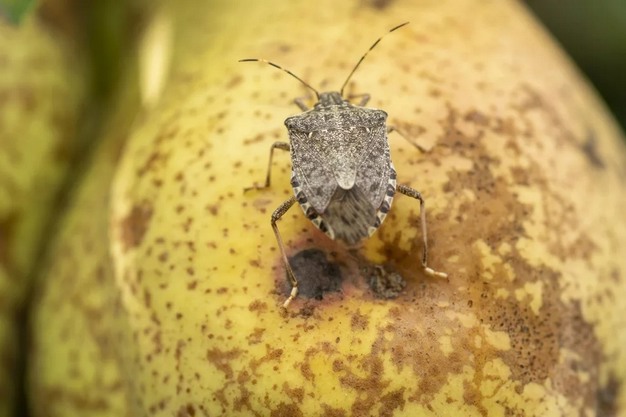
In February, an adult male brown marmorated stink bug (BMSB) was detected in a trap in Ōrākei, near Auckland's port. The find triggered a response from Biosecurity New Zealand, including the deployment of additional traps in surrounding areas. No further insects were detected, and the case has been classified as an isolated detection.
"They can come on imports in containers or in used vehicles and machinery," said Dr Scott Sinclair of the Ministry of Primary Industries. "And they can obviously then come on the passenger pathway, so via people's luggage and other paraphernalia like that."
BMSB is a polyphagous pest feeding on more than 300 host plants. According to researchers at the Bioeconomy Science Institute, it can affect crops including apples, cherries, and kiwifruit. Native plant species may also be exposed to damage. In other markets, the pest has affected fruit production systems.
 © Aotearoa Science Agency
The high-risk period for introduction runs from September to April, when insects may enter via shipping pathways while seeking overwintering sites. Authorities consider the likelihood of entry to be ongoing.
Research is underway to develop biological control options. Work focuses on the samurai wasp (Trissolcus japonicus), a parasitoid species that targets BMSB eggs. The wasp lays eggs inside stink bug eggs, preventing the emergence of the pest.
Although neither BMSB nor the samurai wasp is currently established in New Zealand, approval has been granted for the release of the wasp if BMSB becomes established. Research includes mass rearing, the use of alternative host species, and the development of artificial eggs.
Scientists are also testing attractants based on BMSB chemical signals to support wasp deployment. Trials have shown that imported parasitoid populations can be stored under controlled conditions, with more than 90 per cent survival of female wasps and retention of reproductive function.
"We wanted to try to see for how long we could keep them alive and still be viable," said Karina Santos. "Because one thing is that they survive, but the other thing is that they survive, but they also attack and reproduce."
Operational use of biological control would require scaling of wasp populations and coordinated release strategies. "It's a really cool idea, but it's really difficult for us to operationalise and particularly to operationalise rapidly because there's some really challenging logistical constraints," said Sinclair.
Research continues to focus on preparedness and response options, with authorities monitoring pathways and advising reporting of any suspected detections.
Source: RNZ