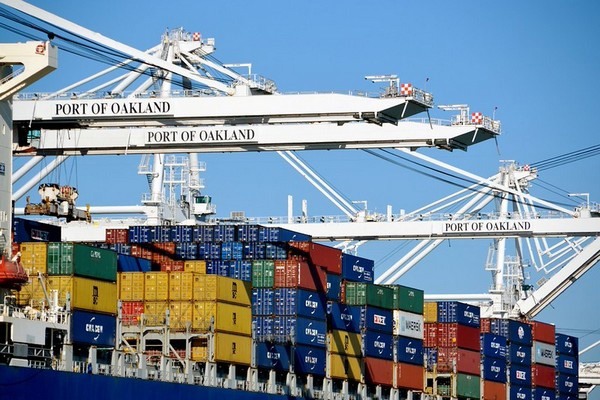
Looking back at February, the Port of Oakland processed 163,254 twenty-foot equivalent units (TEUs) in February 2026, a 16.7 percent decline from January and a 14.5 percent decrease year over year as vessel schedules and capacity were affected by Lunar New Year.
"The February decline is generally in line with the pattern we often see from January to February. From a produce standpoint, it does not look like one commodity suddenly dropped off," says Carolyn Almquist, manager business development & international marketing. "It looks more like normal seasonality, crop timing, and market conditions. Compared to prior years, the direction of the decline is not unusual, even if the size of the month-to-month change varies."
At the Port of Oakland, vessel calls declined from 86 in January to 72 in February, planned blank sailings tied to factory closures during Lunar New Year. Blank sailings are pre-scheduled vessel cancellations used by carriers to align capacity with demand.
 © Port of Oakland
Export vs. import TEUs
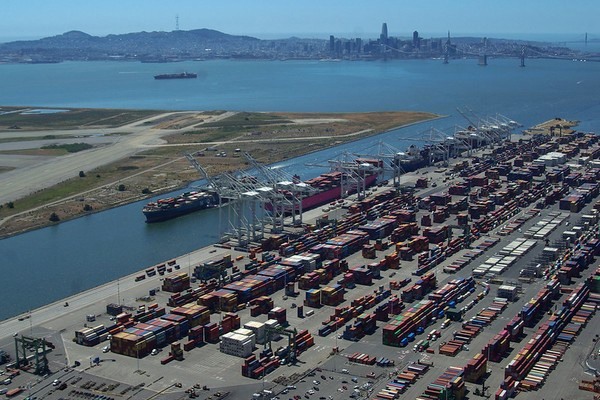
Meanwhile, that month, the Port handled 86,796 export TEUs, outpacing 76,458 import TEUs. "This time of year, export produce is usually centered on citrus, especially oranges and mandarins, along with some remaining apple shipments," says Almquist. "As the season moves forward, that shifts more toward grapes, stone fruit, and fresh vegetables."
"February's volume was shaped in large part by seasonal vessel scheduling around Lunar New Year," said Bryan Brandes, Port of Oakland maritime director. "Even with fewer vessel calls, Oakland's export business remained comparatively resilient, reflecting the Port's continued role as a leader in refrigerated and agricultural cargo."
February 2026 import volumes saw the sharpest decline, falling 19.6 percent year over year, as reduced vessel capacity limited inbound cargo. Export volumes declined 9.5 percent year over year, demonstrating greater stability than imports amid shifting market conditions. "On the import side, produce is a much smaller part of the business and tends to be seasonal," adds Almquist.
 © Port of Oakland
State of demand
Loaded containers totaled 130,192 TEUs, continuing to account for the majority of volume moving through the Port, while empty containers reached 33,062 TEUs. This is indicative of the fact that demand for goods remained firm.
As for Oakland's cargo mix, year to date, loaded containers account for approximately 78 percent of total TEUs, while exports represent about 51 percent of overall volume, underscoring the Port's importance to Northern California's agricultural and logistics sectors.
Looking further back over the past year, Almquist notes that there has been some softening in agricultural exports, though the Oakland-specific picture has held up better than expected. "China has been the weakest point, but the softness has not been across the board. Japan, Korea, and Taiwan have remained relatively steady, with gains in some categories," says Almquist.
Some of the softness also reflects supply and crop conditions. "Citrus has been affected in part by weather-related quality issues, especially in demanding markets like Japan and Korea," says Almquist. "Beef has also been affected by supply constraints. Once dry agricultural commodities are added back in, the picture looks even more stable, with strength in products like nuts and rice helping offset some of the softness in protein and citrus."
Overall, the data suggests the agricultural market through Oakland has held up better over the past year than many expected.
 For more information:
David DeWitt
Port of Oakland
Tel: +1 (510) 627-1100
https://www.portofoakland.com/