According to data from Procomer, Costa Rica's export promotion agency, 53.8% of the country's pineapple exports by volume are destined for North America — primarily the U.S. — while the EU accounts for 34.2%, the rest of Europe 9.3%, neighboring Central American countries 1.4%, and the Middle East 1.1% (data 2025). FOB value figures tell a nearly identical story: 53.2% for North America and 35.3% for the EU. The highest prices last year came from the Middle East at $0.72 per kilo, followed by the EU ($0.61), the rest of Europe ($0.59), and North America ($0.58).
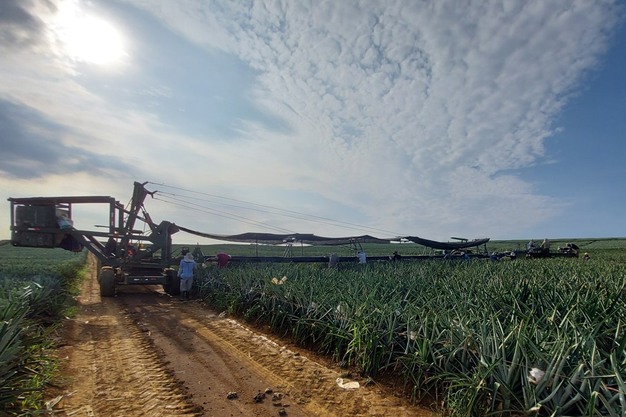 © Hacienda Ojo de Agua
Looking beyond year-to-year fluctuations, exports to North America have grown by an average of 1.9% annually over the past five years, while shipments to the EU have edged down 0.2%. Average prices have risen in both markets, though gains have been more pronounced in the U.S. market (+5.2% per year on average) than in the EU (+4.5%).
Half a million boxes for the open market
Against this backdrop, Hacienda Ojo de Agua — a large-scale Costa Rican pineapple grower with a strong identity built around high Brix levels — is making a deliberate push into the open market. With half a million boxes of new volume planned for 2027, a presence at major European trade shows, and a dehydrated pineapple business already well established across global markets, the company is betting on broader, more diversified commercial relationships.
The farm, part of Grupo Pelón, cultivates 1,500 net hectares of fresh pineapple — exclusively the MD2 variety — and employs 900 people. "We are growers with over 30 years of experience in the Caribbean region, exporting between five and six million boxes of fresh pineapple annually," says Benjamín Piza, the company's head of commercial operations.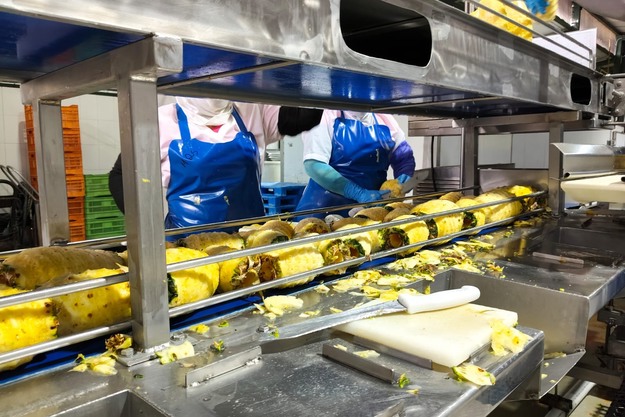 © FreshPlaza
The headline commercial news from Hacienda Ojo de Agua is a significant expansion of its planted area. New growing areas are currently being prepared, with fruit expected from week 25 of 2026. These areas are targeting around half a million boxes for 2027, equivalent to between five and seven containers per week across various sizes.
To support this strategy, Hacienda Ojo de Agua plans to exhibit at Fruit Attraction in Madrid in October and at SIAL in Paris, the latter focused primarily on showcasing its dehydrated pineapple range.
Brix levels well above industry standard
One of Hacienda Ojo de Agua's most distinctive selling points is the sweetness of its fruit. While the industry standard minimum for MD2 pineapple is 12 Brix, the Grupo Pelón grower consistently guarantees a minimum of 14.
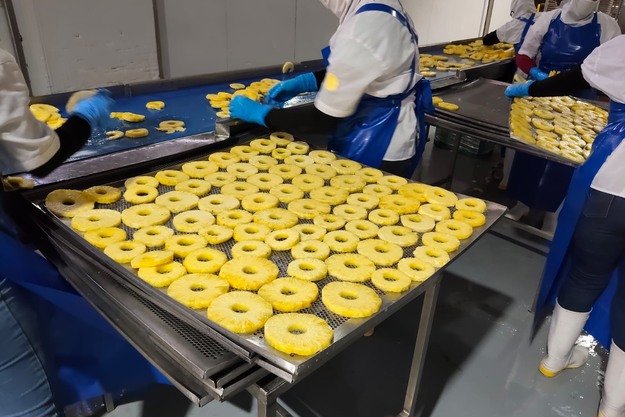
That Brix advantage carries through to the dehydrated product as well: the higher natural sugar content translates into a richer flavor and more intense aroma in the dried fruit — a clear differentiator in an increasingly competitive category.
Nearly thirty years in dehydrated pineapple
Through its Todo Natural brand, Hacienda Ojo de Agua has been producing dehydrated pineapple since the mid-1990s, making it one of the most experienced players in a category that has seen significant growth over the past five years. The product has a shelf life of 12 to 18 months and is sold both in bulk and in consumer packaging, with exports reaching Asia, the Middle East, Europe, and the United States. For Piza, it is "a very appealing snack," and he is clear about his ambition to keep growing this side of the business alongside the fresh expansion.
 © FreshPlaza
Logistics and certifications
Proximity to the port gives Hacienda Ojo de Agua a genuine edge in cost, flexibility, and responsiveness compared to producers based further inland in Costa Rica, according to Piza. The company holds a broad range of certifications: GlobalG.A.P., Rainforest Alliance, SCS (Sustainably Grown), and ISO 50001 for its fresh line, and FSSC 22000, Kosher, and Halal for its dehydrated pineapple — reflecting the diversity of its export markets.
 For more information:
Benjamín Piza
Hacienda Ojo de Agua
San José (Costa Rica)
Tel.: +506 8882-2086
[email protected]
www.todonaturalcr.com