In addition to challenges, climate change also brings new opportunities for commercial vegetable production. Peanuts are among the new, emerging crops in local open-field cultivation. Interest in growing this nut is on the rise in recent years, reports Suyunjon Rakhmonov, product manager at the young plant propagator and distributor Volmary GmbH in Münster.
For several years now, Volmary has been offering two varieties, named 'Mandala' and 'Salomat'. The latter variety is ideally suited for commercial vegetable farming due to its larger and higher-yielding plants and originates from the Central Asian republic of Uzbekistan. Outdoor sowing takes place when the soil temperature is above 18 °C. Optimal growth temperatures range between 25 °C and 30 °C. Sandy, well-drained soils are ideal, according to Rakhmonov. "Last year, we successfully conducted numerous cultivation trials in various regions. Our focus was on broad geographic coverage to test different climatic conditions." So far, the peanuts have been grown throughout the entire DACH region as well as in the Netherlands.
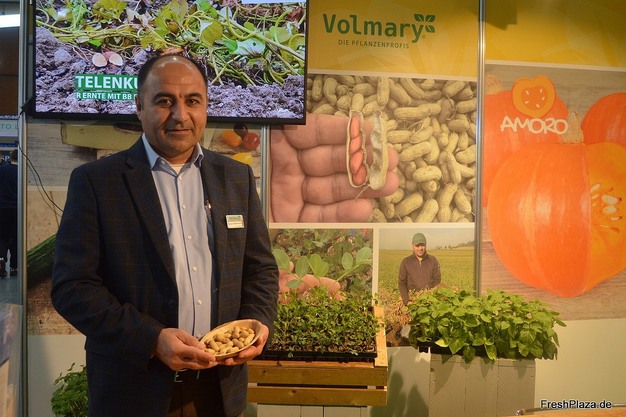 © Hugo Huijbers | FreshPlaza.com
Suyunjon Rakhmonov (pictured here at expoSE 2025) is responsible for the peanut product line at Volmary GmbH.
Peanuts generally require a sunny location and warm temperatures. The growing period is about 19 to 20 weeks (approx. 135 to 140 days) in open fields, depending on the weather conditions. Sowing or planting can be planned starting in late May. The peanuts' ripening period should be considered so that harvesting can typically take place starting in early October, Rakhmonov explains regarding the cultivation process. "We have worked with both large-scale operations and smaller farms. It was important to us to gain insights from both the professional sector and the hobbyist segment to build a comprehensive database."
Growing Interest in the DACH Region
Born and raised in Uzbekistan, Rakhmonov is well-versed in the cultivation and processing of peanuts. As a product manager and consultant, he now shares this experience with both newcomers and experienced peanut growers. In both sectors, he observes growing demand for the Salomat variety. "We are already supplying several agricultural businesses in southern Germany with the appropriate planting material. For the new season, numerous new customers will also be conducting trials with our variety, which we are very pleased about. Interest in our peanuts is growing in Austria (as reported by FreshPlaza.de) and Switzerland."
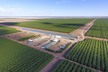
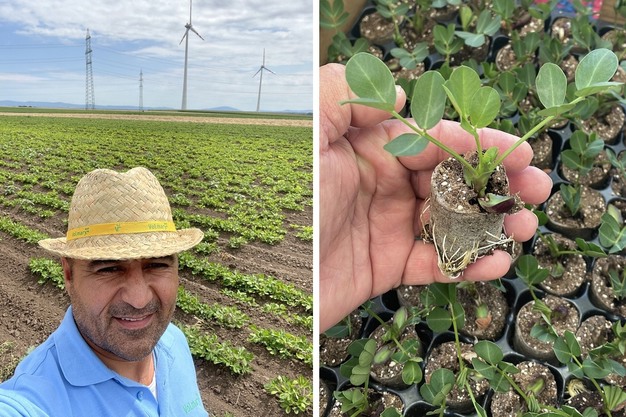 © Volmary
The focus for 2026 is on optimized trial planning to further increase the efficiency and sustainability of cultivation in the aforementioned regions, he continues. "Currently, we can fully meet the rising demand in close consultation with our partners. This process has been very successful so far, and with the inclusion of new farms for 2026, we are well-prepared for further growth." According to Volmary GmbH, the investment-to-return ratio for peanuts is very promising. Since peanuts are legumes, they fix nitrogen in the soil, which can reduce fertilizer costs (including for subsequent crops). If site conditions (soil quality and temperature) are right, the achievable final market price clearly justifies the initial costs for seed and soil preparation.
Profitability, or the ratio of input costs to final price, is attractive but depends on operational conditions. Rakhmonov: "Peanuts are a highly mechanizable crop. Based on my own experience and available documentation, sowing, weed control, and harvesting can be carried out fully automatically. This makes the crop particularly interesting for farms with modern agricultural technology, as labor costs can be minimized."
High potential in organic farming
Volmary currently sees the greatest potential for peanut cultivation in the organic sector, although both sectors benefit from climate change. "The reason for this lies, on the one hand, in nitrogen fixation: As a legume, the peanut binds nitrogen in the soil. In organic farming, where synthetic fertilizers are not used, this offers a massive ecological and economic advantage for crop rotation. On the other hand, it is also related to market trends: In Germany, Austria, and Switzerland, demand for regional organic food remains consistently high. The attractive retail prices in the organic segment, which are clearly visible in stores, justify the transition to organic farming."
The combination of "regionality" and "organic certification" is currently a strong selling point that enables higher margins than the conventional mass market. "While conventional farming is efficient due to automation, the organic sector currently offers the most promising prospects in the DACH region thanks to soil improvement and consumers' high willingness to pay," concludes Rakhmonov.
For more information:
Suyunjon Rakhmonov
Volmary GmbH
Kaldenhofer Weg 70
48155 Münster
Fax: +49 (251) 27070 166
[email protected]
www.volmary.com