The commercial vegetable greenhouse sector in North America generally started by adopting seeds and technology from Europe. "However, for strawberries it wasn't that easy as in many ways the strawberry markets on the two continents are very different," says Paul J Mastronardi with Red Sun Farms. "We've taken a different approach with the goal to produce a specific greenhouse tailor-made solution for the North American market," he added.
To achieve this goal, Red Sun Farms started a partnership with Heritable and CIV from Italy. Together, they are using cutting-edge, AI-driven breeding to bring high quality, local, sustainable strawberries to market. "It is our mission to lower the costs, accelerate the timelines, and bring cutting-edge genetics to new markets," says Brad Zamft, CEO of Heritable, a spin-out of Google's Moonshot Factory, called Google X. "This strawberry program is an excellent example of just that."
Zamft joined Google X in 2018 and started a program aimed at developing AI tools to accelerate crop improvement. They ran field trials in seven species over several years in order to get the custom, AI ready data sets to build and train their models. Their focus was mainly in row crops, until 2023, when they met Paul J. Mastronardi. Paul, who had been struggling with getting the best genetics for his particular market, brought to Heritable the vision of applying their technology to greenhouse grown strawberries.
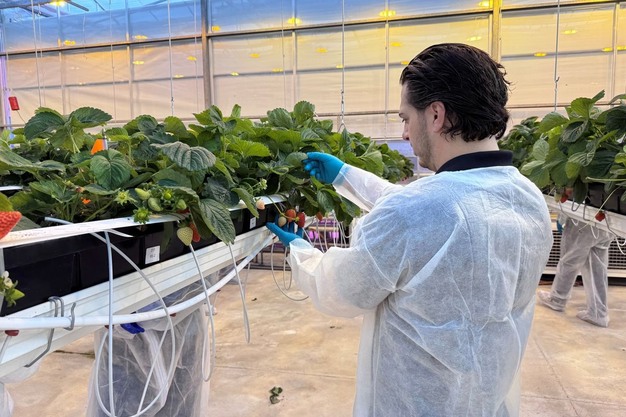 © Red Sun Farms
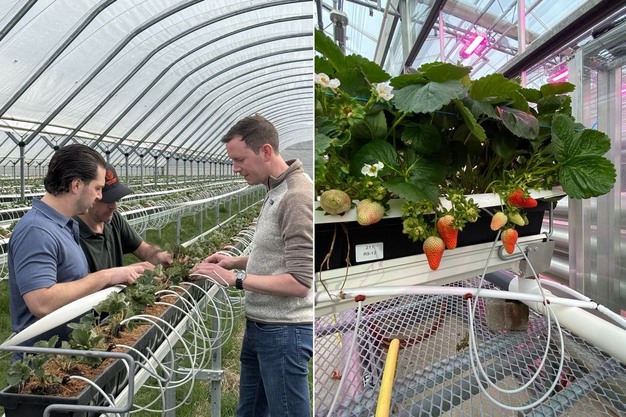
Paul J Mastronardi in the strawberry greenhouse.
Consumer and retailer feedback
"What is unique about this venture is that until now, it hasn't been justified to develop a bespoke breeding program with varieties that contain key traits for indoor agriculture in the North American market and also bring the voice of the consumer," shared Zamft.
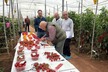
To better understand the precise qualities the consumer is looking for, Heritable and Red Sun Farms have run two "retailer demo days," where retailers sample the current, pre-commercial strawberries and give their feedback. "While we learn from our retail partners, they also have the opportunity to get more understanding of the growing side of the operations and the economics involved. Basically, we have more of an open dialogue, creating a win-win for both sides," commented Mastronardi. "This is the first time retailers are talking with the breeder and that information has propagated all the way from the early part of the discovery pipeline to retail and back."
So far, retailer feedback has been extremely positive. "In view of recent weather events such as California rains and a freeze in Florida, retailers are excited for a model that aims to offer more consistency in supply and flavor," mentioned Mastronardi.
Three-legged stool
It's Heritable's job to put the pieces of the puzzle together. "We have access to excellent starting genetics through CIV's extensive strawberry varieties, which were specifically bred for outdoor environments in Europe," said Zamft. "We also know what the consumer wants through Paul's extensive network in retail. He sells to the largest grocery chains in North America every day." The last piece of the puzzle is how to customize those genetics in a way that justifies the investment. "That's what Heritable brings," said Zamft.
 © Red Sun Farms
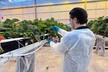
Strawberry trials
The main focus is to build a 52-week strawberry program between greenhouse and tabletop varieties. The phase I trial ran from April until November 2025 with 25 different varieties that were planted in a tabletop setting. In September 2025, the Phase II trial started with 110 different varieties grown in a greenhouse with supplemental lighting. This crop will carry until July 2026. While the crops from these two trials are all grown at Vineland's Research Centre in Niagara, Ontario, this will gradually change. The next trials will start taking place at grower sites in Canada and the U.S., as it is important to get variation in environments and management.
Selecting the best genetics
The Heritable team has collected DNA, RNA, weather, and management information from the trials. Their models are then able to integrate that heterogenous data, predicting how a strawberry plant or cross will perform. "We use our models to select the best existing genetics, but also to identify how to cross the parental lines to make better new lines," Zamft shared. Heritable's AI models are also being used to identify the exact genes and maybe even the exact bases in the DNA that can confer specific changes to flavor, fruit morphology, color, disease resistance, yields, etc.
Breeding time of four years
"The information that has been collected from Phase I and II in combination with consumer and retailer feedback allows us to start breeding the different varieties together this upcoming fall," shared Mastronardi. "We are using traditional breeding methods and once all varieties have been crossed, they will be planted with the goal of a commercial launch in 2029." The average time to bring a new strawberry variety to market is seven to ten years. "We aim to launch commercially within four years from inception to market launch, probably a world record," said Zamft.
CPMA Toronto
Today, Zamft will be part of a panel discussion about the Future of Predictive Breeding at World Agri-Tech in San Francisco. The team will also be exhibiting at CPMA in Toronto on April 29 and 30, at booth #1721.
 For more information:
Leona Neill
Red Sun Farms
[email protected]
www.redsunfarms.com
www.heritable.ag