Growcer has launched a national philanthropic initiative aimed at expanding community-based food production across Canada. The Fresh Solutions to Community Hunger campaign, introduced through the Food Resiliency Foundation and powered by Growcer, aims to raise $15 million to activate food infrastructure projects in communities that have already completed planning but lack the final capital needed to move forward.
"For ten years, Growcer has worked alongside food banks, Indigenous communities, schools, and hospitals across Canada to help them grow their own food," says Corey Ellis, Co-Founder and CEO of Growcer. "That work exposed us to hundreds of organizations building a stronger food system. But it also illuminated where projects get stuck."
"There are charitable organizations across this country that have done everything right. They've identified the need. They've selected their site. They've built their team. All they need is the last piece of funding to get across the finish line."
Unlocking the final 20 percent
The campaign is designed to close that funding gap by financing the remaining share of project costs for initiatives already within Growcer's network. "The Fresh Solutions campaign is raising the final 20% of project costs to activate 100 communities. That's 100 local food projects that are ready to go within our network," Ellis says.
"Every dollar raised is matched 3:1, turning $15m into $60m in community food infrastructure. That's not simply fundraising. That's leverage," says Alida Burke, Co-Founder and CFO. According to Growcer, the campaign's financing structure combines multiple funding sources to reach that scale. The $15 million philanthropic campaign is expected to leverage approximately $45 million from additional sources, including public grants, client contributions, and financing or support from local donors, creating roughly $60 million in blended finance for community food infrastructure.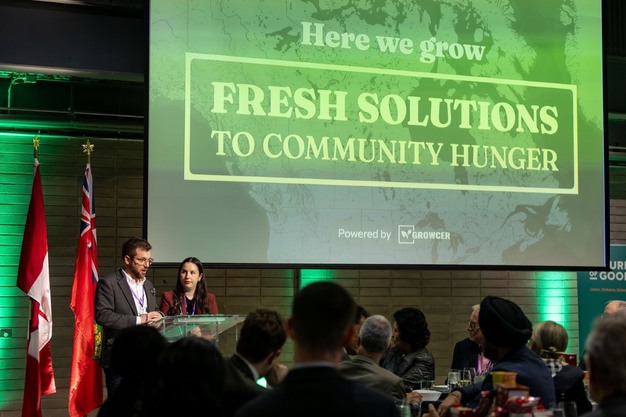 © Growcer
Growcer's founders, Corey Ellis and Alida Burke
Addressing a growing national challenge
The initiative comes at a time when food insecurity is increasingly recognized as a structural challenge in Canada rather than a temporary crisis. In campaign materials, the organization notes that one in four Canadians struggles to access sufficient and nutritious food. Rising housing costs, food inflation, climate disruption, and supply chain instability have placed additional pressure on food banks and community organizations that are already operating at capacity.
"The traditional response, emergency food relief, cannot solve this alone," Ellis says. "Communities should not have to wait for a donation to eat. They should have the infrastructure, the training, and the support to grow their own food, on their own terms, year-round."
Building on a decade of deployments
Growcer's model focuses on modular hydroponic farming and food-storage infrastructure designed for year-round operation in diverse climates, including northern regions where temperatures can drop below −40 degrees Celsius. The company has worked with more than 150 community partners across Canada since its founding in 2016, providing equipment, training, and funding support to enable local food production.
Beyond modular farms, the initiative can support a broader range of food resiliency infrastructure. This includes solutions for cold and dry storage, food hubs, greenhouse systems, and processing capabilities, as well as site preparation costs, feasibility work, and training needed to establish and operate local food systems.
According to Growcer, funding from the Fresh Solutions campaign flows directly to registered charities operating at arm's length from the company. Participating organizations must demonstrate strong governance and financial management and are required to follow competitive procurement processes. Growcer is therefore not automatically selected as a supplier, and conflict-of-interest policies govern all funding decisions.
What the model has delivered so far
Early deployments have produced measurable outcomes. According to Growcer, projects supported through its network currently generate 5.3 million meals incorporating locally grown produce, 608,000 servings of vegetables produced, 111,916 food hampers distributed, and 5.2 million liters of water conserved.
Florent Schmahl, Chief of Staff at Growcer, notes that these figures represent annual outputs from a subset of Growcer's network that participated in an earlier proof-of-concept initiative supported by a $1.5 million donation from the RBC Foundation. "This proof-of-concept is helpful to show future donors how their dollars will have an impact and reiterate that this is a proven model that's been executed in various communities and non-profits already."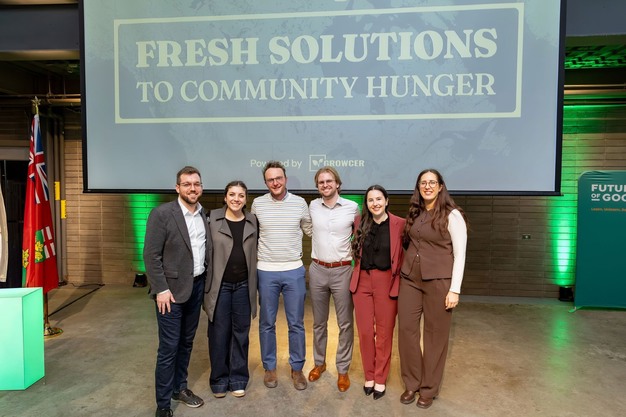 © Growcer
From left to right, Growcer's Corey Ellis, Carla De Ciccio, Florent Schmahl, Jacob MacLeod, Alida Burke, and Stephanie Gordon
Community readiness and deployment timeline
Schmahl says the next phase will extend the model to additional communities across the country. "With the launch of this campaign, Growcer, with its partners, aims to collaborate with 100 new communities across Canada to grow food and grow potential sustainably. Together, we are addressing food security at its core by implementing local food infrastructure that makes fresh, nutritious food accessible while developing critical skills."
Many of the communities involved have already expressed interest in implementing local food infrastructure, though they are at different stages of readiness. Growcer evaluates projects through what it describes as a "Project Success" framework that considers factors such as where infrastructure will be located, how operations will be managed, how food will be distributed, who will benefit from the program, and how projects will be financed.
Based on those assessments, Growcer works with communities to strengthen their readiness, which may involve developing operational capacity, providing training, or completing feasibility work before infrastructure is installed. Because communities are progressing at different stages, deployments are expected to take place over approximately three years.
While many potential partners are already in discussion with Growcer, the organization says it will also formalize the network process in the coming months, allowing additional organizations to opt in to participate.
Education and local ownership
The funding structure allocates the majority of campaign resources to building new community farms. A portion of the funding will also support agricultural education programs reaching tens of thousands of students.
Burke notes that the impact extends beyond food production itself. "These projects mean local jobs, local food infrastructure owned by food banks, schools, and hospitals, and 50,000 students gaining hands-on food systems education," she says. "Communities feeding themselves, on their own terms."
A collaborative launch
The campaign was formally launched during an event that brought together philanthropic organizations, policymakers, and community partners, including representatives from the Regina Food Bank and elected officials from across Canada.
For Growcer's team, the gathering reflected the collaborative approach required to scale community food infrastructure. "This campaign doesn't just raise money for local food projects, it unlocks them," says Stephanie Gordon, Senior Content Manager at Growcer. "Sites are selected, teams are in place, a need and a solution are identified. They're 80% of the way there, but they need help for the remaining 20%."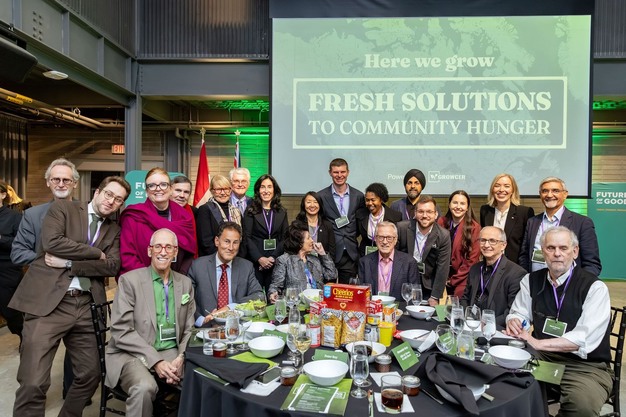 © Growcer
Toward national scale
While the current campaign focuses on 100 projects, Growcer's longer-term ambition is significantly broader. Schmahl says the initiative is intended to serve as the foundation for wider deployment across the country. "We are now scaling this initiative and mobilizing $15M to support 100 more community partners, with a goal to reach 1,000 Canadian communities in the next five years."
The first one hundred communities represent what Growcer describes as the campaign's initial milestone. Beyond that phase, the organization sees significantly larger potential for expansion. "To actually make a dent in Canada's dependency on fresh greens imports, our ambition is 1,000 communities," Schmahl says. "Consider 100 communities as our first milestone, but the campaign will not stop there."
For more information:
Growcer 
Stephanie Gordon, Senior Content Manager
[email protected]
www.thegrowcer.ca