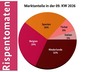
A wide range of tomatoes was available, with numerous countries involved. Spanish deliveries dominated, followed by expanding Belgian and Dutch supplies. The quality of the offerings from Turkey and Morocco was no longer consistently convincing, and even the Spanish loads sometimes struggled with freshness. The supply was rounded off by Italian and Egyptian inflows. According to the German BLE, the spring-like weather had increased demand, but it was still possible to meet demand without any major effort. Prices tended to fall for the most part. However, even the reduced demands of traders did not always guarantee clearance. In Munich, for example, surpluses built up that could not be placed even before the weekend. As a result of the inconsistent quality, a wide price range established itself in some places.
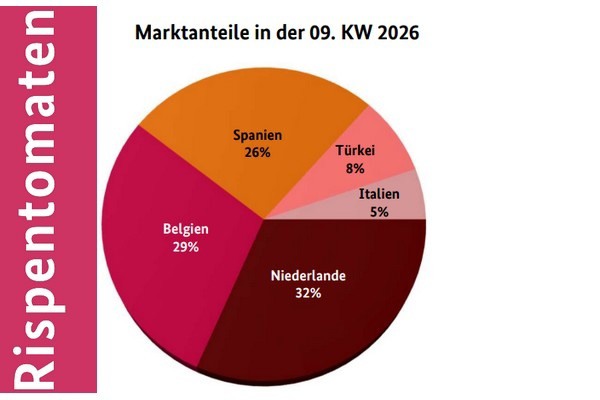 © BLE
© BLE
Price increases were very rare, although customers in Berlin had to dig a little deeper into their pockets for cherry tomatoes. In general, availability was still relatively low: flooding in Africa and recent rainfall in Spain made growing conditions difficult. Fruit from the Netherlands and Belgium still lacked sunlight, which is why it is not yet particularly ripe. However, the current sunny and warm weather will have a positive effect on ripening.
Click here to go directly to the full market and price report.
Apples
Domestic products still dominated the range of goods, but availability was slowly but surely declining. A few varieties had already disappeared from the market. The presence of Topaz, Wellant, and Tenroy decreased.
Pears
Once again, Italian Abate Fetel played the leading role, ahead of Turkish Santa Maria and Dutch Xenia. Turkish Deveci and Italian Santa Maria and Williams Christ followed. The presence of European loads decreased. In contrast, South African imports increased.
Table grapes
South African imports clearly dominated the market, with supplies from Namibia and Peru supplementing it with much smaller quantities. Overall availability was very high and often exceeded storage capacity. Demand was rather weak.
Oranges
The range became increasingly scarce and a certain degree of saturation on the customers' side could not be denied: demand weakened noticeably. As is not unusual at this late stage of the season, some loads were also suffering from quality issues. This led to a wide price range in some cases.
Small citrus fruits
Spanish mandarins dominated, followed by Israeli, Turkish, and Moroccan mandarins in terms of volume. In addition, a small amount of Italian and Egyptian supplies were available. Although availability was limited, it was easily sufficient to satisfy demand. Higher temperatures had caused demand to shrink noticeably.
Lemons
Business was quiet across the board. Spanish Primofiori dominated and were available in almost monopolistic quantities. They were accompanied by very small quantities from Turkey and Italy. There were generally no noticeable price changes.
Bananas
Supply and demand were sufficiently in harmony that traders rarely had reason to modify their previous demands. Only in Munich did prices rise slightly after the end of the winter holidays, as storage facilities had improved.
Cauliflower
Italian deliveries predominated over French and Spanish ones. In Frankfurt, there were also a few Dutch deliveries. Demand was easily met. However, from the middle of the week onwards, as temperatures rose, storage conditions deteriorated.
Lettuce
Iceberg lettuce mainly came from Spain, with only Frankfurt also seeing supplies from Greece. At times, a relatively wide price range emerged, caused by inconsistent quality. In Munich, demand intensified significantly towards the weekend, preceded by discounts.
Cucumbers
With the first arrival of German produce and increased deliveries from the Netherlands and Belgium, there was movement in the range of cucumbers. Spanish loads still dominated the market but lost considerable market share.
Bell peppers
Supplies from Spain increased and Turkish imports also rose. Together with Egyptian and Moroccan loads, it was possible to meet demand.
Source: BLE