Bananas—the most widely consumed fruit in the world and loved by young and old alike—are under growing pressure. Black Sigatoka, Moko, and, above all, Panama disease are the biggest threats. The latter in particular is wreaking havoc on banana production. A Better Choice (ABC) aims to tackle this challenge with a solution known as UV-C. The real innovation isn't so much the technology itself, but the smart way it's been tailored specifically to bananas, and made accessible to smaller-scale growers as well.
A lot is at stake. Roughly half of all bananas worldwide—and virtually the entire export trade—consists of the Cavendish variety. And Cavendish is particularly vulnerable to TR4, an aggressive fungus that causes Panama disease and for which there is no cure. Its full name is Tropical Race 4, a strain of Fusarium oxysporum f. sp. cubense that attacks the roots. Infection often means the end of a plantation, and years in which bananas can no longer be grown on the affected land, because the fungus can survive in the soil for decades.
After first being identified in Asia in the 1970s and spreading through Africa from 2013 onwards, TR4 appeared in Latin America in 2019, where around two-thirds of export bananas are grown. It spreads mainly through infected planting material and through tiny soil particles carried by animals or stuck to machinery, vehicles, shoes, and clothing. That's why biosecurity is essential, including disinfecting tyres, tools, and clothing.
 © A Better Choice
Besides TR4, Black Sigatoka and Moko also threaten banana production. Black Sigatoka is a fungus like TR4, but it causes a leaf disease, can be spread by wind, and can be controlled with crop-protection products. Moko is a vascular disease caused by the bacterium Ralstonia; it spreads via planting material, tools, and soil, but also through insects. One advantage is that Ralstonia does not persist in the soil for long periods; after infected plants are destroyed, restarting production may be possible.
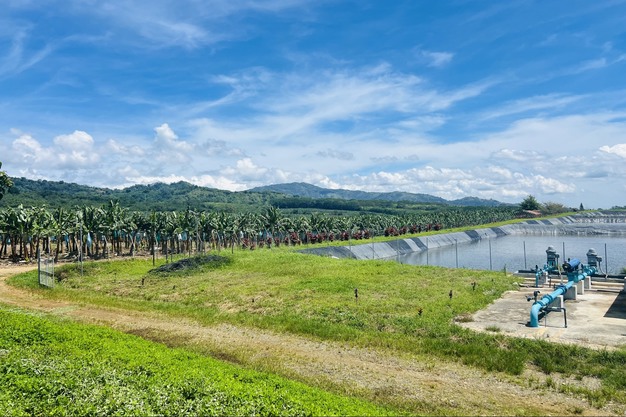
Not only are infected planting material and soil particles carried along, but spread TR4 and Ralstonia irrigation and drainage systems also contribute significantly to the further spread of both pathogens. For irrigation, growers increasingly use river water, and if that water is contaminated with TR4 or Ralstonia, it undermines every other biosecurity measure. That is exactly where ABC positions itself, with a solution based on UV-C.
UV-C water disinfection
"Everything starts with water," Jasper van Roon, co-founder of A Better Choice, says firmly. That's why we've developed compact units that can purify irrigation water of TR4 and Ralstonia."
 © A Better Choice
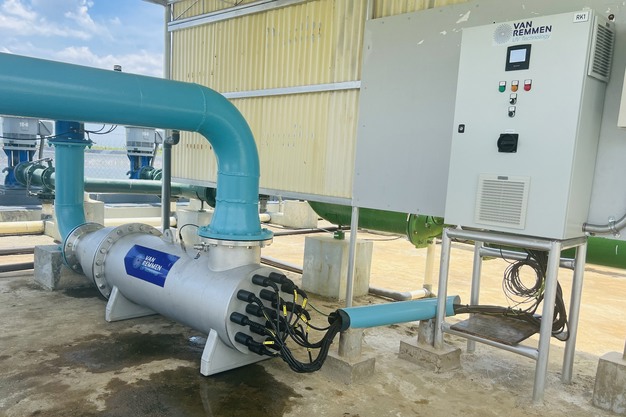
UV-C is the most powerful form of ultraviolet radiation. "It breaks down the DNA structure of both pathogens. No DNA, no reproduction, no infection," Jasper explains. UV-C isn't new, nor is it new to the banana sector. In Europe, it has been used for decades: in drinking water treatment, to control algae in ponds, and in greenhouses. "That's how our first units were developed with a supplier from the swimming pool and pond industry. They've now been running for two seasons in Ecuador."
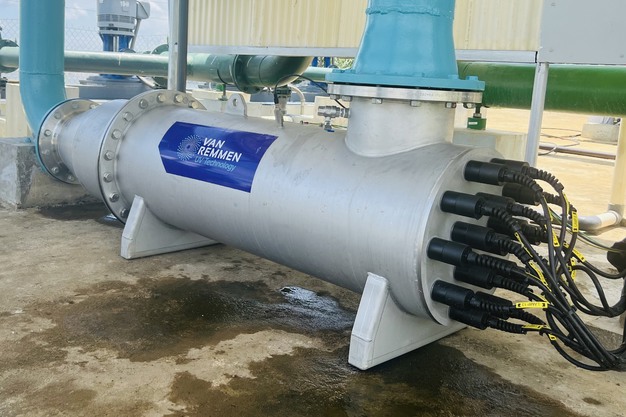
When growers started asking questions about energy use, efficiency, and cost, A Better Choice continued development together with Dutch technology partner Van Remmen UV Technology, Wageningen University & Research, and its own team in the Philippines. That resulted in the H-Series, designed for the realities of banana farming. "The biggest problem we solved was how to apply UV-C in a field setting," Jasper says.
Van Remmen has always been at the forefront of UV-C system development and validation, working closely with Wageningen University and several leading Dutch water research institutes. "The name says it all: disinfection. Our technology is designed to eliminate infection, which makes it a critical part of water treatment systems", says owner Ton Van Remmen, explaining why cooperation and research are central to the company's mission: safe and clean water for everyone. "We are committed to delivering the highest level of safety at the lowest total cost of ownership, an approach that is embedded in all our developments and validated products."
 © A Better Choice
"The biggest problem we solved was how to apply UV-C in a field setting," Jasper says.
"A flow plate directs the water around the UV lamps, increasing contact time with the light while reducing energy consumption. Instead of bringing the light to the water, we bring the water to the light," Van Remmen explains. This allows UV-C light to permanently damage the DNA and RNA of viruses, bacteria, and even fungi, without the risk of resistance associated with chemical biocides and antibiotics. As a result, UV-C is one of the few reliable chemical-free disinfection methods that can be applied efficiently without consuming large amounts of resources.
The first unit in the Philippines needed 38 lamps of 400 watts to disinfect 285 m³ per hour (15.2 kW). The H-Series achieves the same UV-C dose (800 joules) with 24 lamps of 325 watts: 7.8 kW—almost half. "Same effectiveness, but far cheaper, both to purchase and to run," Jasper says. "It's the result of a holistic approach: combining knowledge and experience, science and proven technology, with one goal: helping banana growers," Roland Heringa, founder of ABC, adds.
Field trials
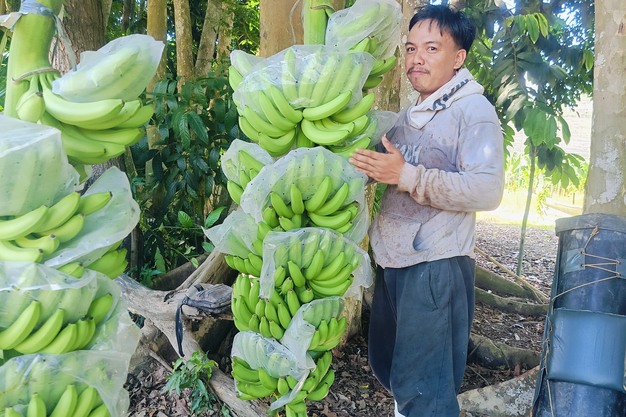
After three years of lab tests and field trials in the Philippines, the system was launched at the most recent Fruit Logistica. UV-C water disinfection is especially crucial in regions where contaminated irrigation water is the norm. "Where access to groundwater is limited, people fall back on river water, often contaminated," Roland says.
 © A Better Choice
"We combine knowledge and experience, science and proven technology, with one goal: helping banana growers," Roland Heringa, founder of ABC, says.
River water is usually turbid. That's why transmittance measurements are taken in advance to determine how much UV light the water can transmit. "The units also measure transmittance continuously and warn you when values become critical. If the value is too low, the system can automatically reduce the flow rate," Jasper comments, ensuring disinfection levels remain effective.
From smallholders to industrial-scale fields
Chlorination systems are common, but ABC would rather offer an alternative. "Chlorine needs contact time; when you're in a hurry, it often doesn't work properly. And it's chemistry, harmful to soil, plant and people," Jasper says. UV-C leaves the water chemically unchanged: "We destroy the DNA, and that's it. No residues."
 © A Better Choice
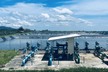
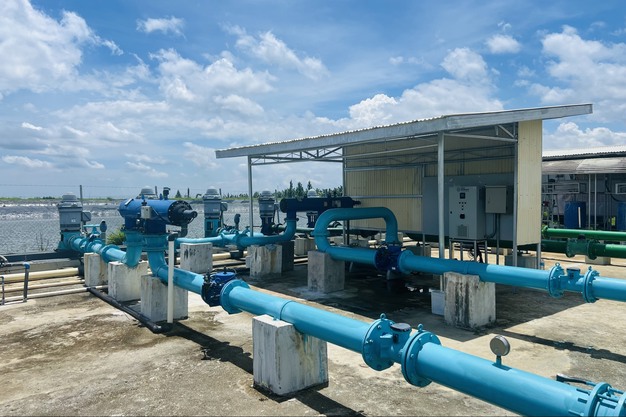
Together with Van Remmen UV Technology, Wageningen University & Research, and its own team in the Philippines, ABC has developed the H-Series for disinfection of irrigation water for banana plantations.
The system is scalable: from small units (325 watts, 2–3 m³/hour) for plots of 0.5 hectares to industrial installations for hundreds of hectares (250–300 m³/hour). "Those small units last 2 to 4 years and are economically viable. We have 19 unit types ready for immediate deployment, tailored to irrigation needs worldwide," Roland concludes.
A scientific publication will follow soon.
 For more information:
Jasper van Roon (COO)
A Better Choice
Rijksstraatweg 145
7391 MK Twello (The Netherlands)
Tel: +31 (0) 6 52321450
[email protected]
www.abetterchoice.nl