Last Friday, the Supreme Court of the United States ruled that President Donald Trump's tariff policies under the International Emergency Economic Powers Act (IEEPA) are unconstitutional. Subsequently, President Trump signed an executive order to impose a 10 percent "global" tariff–a figure that was raised the next day to 15 percent.
In turn, today, many in the industry are unsure of what exactly this will mean. "I have no idea–we don't know when we will be fined again and how much. At this point, nothing changes but insecurity is increasing," says Elena Kong of Love April. "The customs broker doesn't know what is going to happen, importers don't know the costs, and the customers don't know how much they'll end up paying."
"We are being very cautious regarding the new announcement from last week," says G.T. Parris of Greenyard USA/Seald Sweet. "Like many in our industry, we were somewhat surprised by the ruling from the Supreme Court of the United States — whether it is correct or not is not for us to debate. The subsequent response from Donald Trump has only added further uncertainty as to where this situation may be headed."
Clarity with the State of the Union?
He notes that in turn, the company's growers have been calling and asking what this means for the upcoming season. "Unfortunately, we do not have a clear answer at this time. We will be watching the State of the Union address closely in hopes that it provides additional clarity. However, it appears this may ultimately be decided through legal channels, which could take weeks or even months," says Parris.
It's an additional challenge given these tariffs are applying to food which is an essential item. "With the new food pyramid guidelines in place, we would hope these products would be left out of political uncertainty so the focus can remain on lowering prices for consumers and ensuring families continue to have access to fresh fruits and vegetables," adds Parris.
"The ongoing changes to tariffs have created significant turmoil for our industry, leaving us yearning for clarity amidst the confusion," notes Anthony Serafino of Exp. Group LLC. "This constant state of uncertainty is not sustainable, and we feel we are owed a refund in light of the decision. We align with the Supreme Court's position on the implications of these tariffs."
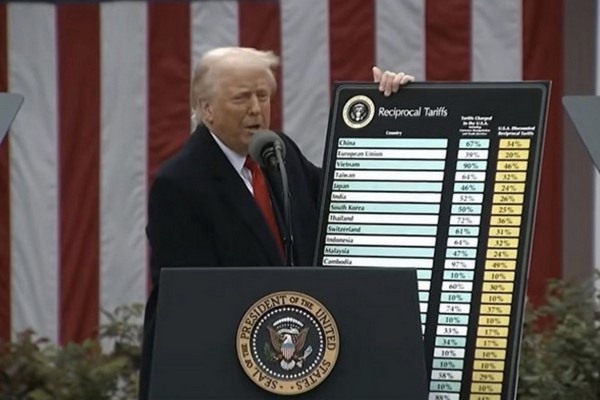 © Donald TrumpPresident Trump announced tariffs on April 2.
Costs and companies and affordability
He also notes that the escalating costs associated with these tariffs are placing a tremendous burden on the company's products, which directly impacts consumer affordability, an issue that is increasingly critical for customers. "We are anxiously awaiting further clarification on what these developments will mean for our operations and their broader implications for the market. Just as it seemed we were beginning to achieve some stability with recent trade agreements, we find ourselves confronted with yet another unexpected challenge stemming from an executive order issued by the Trump Administration. This has added an additional layer of complexity to an already volatile situation," says Serafino.
On Friday, the International Fresh Produce Association (IFPA) put out its statement following the Supreme Court announcement. "IFPA welcomes the Supreme Court's decision clarifying the limits of the International Emergency Economic Powers Act and reaffirming that broad, country-specific tariffs fall outside its intended scope. The global trade of fresh produce is essential to the health and well-being of people in every nation, and today's ruling helps restore predictability to a uniquely complex, seasonally driven marketplace."
Next steps
For dVida, as tariff regulations continue evolving, our approach has been to remain flexible and responsive as new information becomes available. "Given the day-to-day nature of these developments, we have made a deliberate decision in many cases to absorb tariff-related costs to prevent disruptions to our customers' programs and orders. Adjusting pricing mid-program, particularly after commitments have been made, can create unnecessary challenges, so maintaining consistency and reliability has been a priority for us," says dVida's Cristina Jacome.
She notes that on Tuesday, the company expects to receive updated guidance from U.S. Customs regarding the status of the new preferential trade agreement between Ecuador and other South American countries and the United States, specifically as it relates to certain commodities.
"Once that list is published, we will have greater clarity on how some of our key items — including bananas — will be affected," she says. "Because our focus is on South American tropical fruit that is not grown domestically in North America, we are not directly competing with U.S. producers. That distinction has helped sustain demand even amid pricing fluctuations tied to tariff changes. While the regulatory environment remains fluid, our strategy is centered on adaptability, transparency, and protecting supply continuity for our customers.
For more information:
Elena Kong
Love April
https://www.loveapril.net/
G.T. Parris
Greenyard USA/Seald Sweet
www.sealdsweet.com
Anthony Serafino
Exp. Group LLC
www.expgroup.us
International Fresh Produce Association
https://www.freshproduce.com/
Cristina Jacome
dVida
www.dvidaco.com