With candid words on the economic situation and clear expectations of politics and the market, the 43rd Bodensee-Obstbautage (Lake Constance Fruit Growing Days) opened on Friday as part of Fruchtwelt Bodensee in Friedrichshafen. Despite stable harvest volumes, many businesses are under considerable price pressure. At the same time, the sector is focusing on research, digitalization, and technical innovation to actively shape its future.
Click here to go directly to the full photo gallery.
"Fruit growing on Lake Constance is part of our state's identity, which must be preserved and strengthened," emphasized State Secretary Sabine Kurtz from the Baden-Württemberg Ministry of Food, Rural Affairs, and Consumer Protection at the start of the trade fair. Despite ever-increasing challenges, the sector is holding its own, primarily due to its adaptability and flexibility.
"We must remove bureaucratic hurdles and create incentives for investment in modern, sustainable technologies so that fruit growing in the state remains attractive for the next generation," said the state secretary. "Fruchtwelt Bodensee is an important forum with international attention. As a leading trade fair, it provides guidance and creates space for exchange within the sector."
 © Hugo Huijbers | FreshPlaza.com
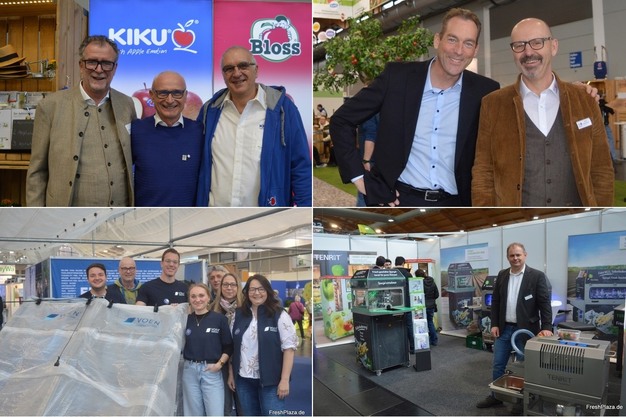
Exhibitors at this year's Fruchtwelt Bodensee. Clockwise: Jürgen Braun from Adema with partners from SalemFrucht and Seefrucht GmbH, OvB CEO Tim Strübing with Erich Röhrenbach, Chairman of Obstregion Bodensee e. V., first-time exhibitor Sascha Wietbrauk from Tenrit GmbH, and the team from VOEN Vöhringer.
Good harvest, but difficult price situation
The chairman of Obstregion Bodensee, Erich Röhrenbach, focused on the economic situation of the sector. The 2025 apple harvest in the Lake Constance region amounted to around 250,000 tons of dessert apples, with 1.1 million tons across Germany and 10.9 million tons in the EU. This quantity was actually easy to market. Nevertheless, it became apparent that there was no guarantee of adequate producer prices. Prices for the standard range had recently been "disastrous". This must be taken as an opportunity to analyze the situation honestly and then take action. Röhrenbach warned that individual production areas could exceed their volume targets and trigger ruinous price competition through ongoing promotional sales.
At the same time, he pointed out the importance of in-house breeding in the regional climate context. The new "Mammut" variety, for example, has been promoted for three years. It is the first variety to be developed as part of the regional FAIRDI initiative by Obstregion Bodensee e. V. and the Kompetenzzentrum Obstbau Bodensee (Lake Constance Fruit Growing Competence Center). The aim of the initiative is to bring robust and climate-adapted varieties with high fruit quality to the market. The breeding work exemplifies the goal of making fruit growing more sustainable and viable in the long term.
Claus Schliecker, chairman of the Federal Fruit Growing Group, pointed to structural pressures in fruit growing. For example, no value-adding prices were achieved last season. Rising minimum wages led to additional costs in the six-figure range per year for many businesses. Added to this were restrictions on the approval of plant protection products, questions regarding third-country regulations for harvest workers, and increasing bureaucratic requirements. "We want to produce fruit and not spend our time in the office filling out paperwork and documentation," said Schliecker.
Digitalization and risk prevention
At the same time, it became clear that the sector is actively working on solutions for the future. Hubert Bernhard, president of the State Association of Commercial Fruit Growers in Baden-Württemberg, emphasized that tomorrow's fruit growing will be more digital, more precise, and more intelligent. Robotics, artificial intelligence, sensor technology, and drone technology are no longer a vision but a concrete practice. They enable a more targeted use of resources as well as efficiency and sustainability. However, the prerequisite for investment is planning security. "Those who expect innovation must enable risk prevention." The further development of multi-risk insurance is an important building block for the future of the sector. Currently, however, there are major problems in getting all businesses onto the insurance policies.
From a research and consulting perspective, it is crucial not to respond to change with fear but to clearly analyze strengths, opportunities, and risks, emphasized Dr. Manfred Büchele from the Kompetenzzentrum Obstbau Bodensee. Good products, reliable partnerships, modern technology, and research are key starting points.
In the subsequent panel discussion on changing consumer behavior, the focus was on the market and consumers. According to market research, apple consumption has declined in recent years, especially among younger target groups. At the same time, it was emphasized that apples continue to represent regionality and German fruit. Other types of fruit, such as avocados and blueberries, have gained in importance. New formats, a stronger focus on consumer needs, and a more active approach to younger target groups were also discussed. In the debate on pesticides, participants referred to the high safety standards of the existing approval system.
For more information:
www.fruchtwelt-bodensee.de