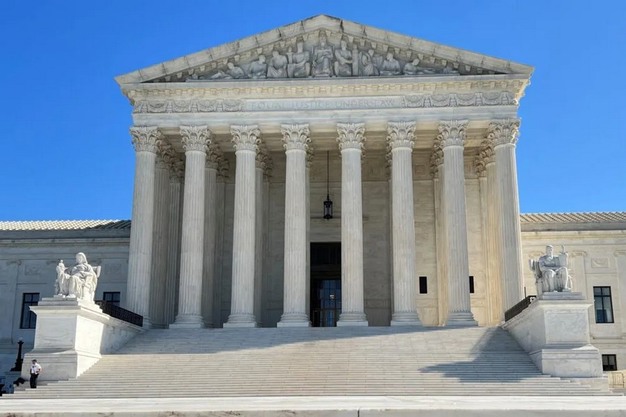
Exporters to the United States are facing renewed tariff uncertainty after the U.S. Supreme Court ruled that President Donald Trump had overstepped his authority in imposing so-called "Liberation Day" tariffs under the International Emergency Economic Powers Act (IEEPA).
The court found that while IEEPA allows the president to "regulate commerce" to address an economic emergency, it does not authorize the use of tariffs. The ruling casts doubt on a broad swathe of duties imposed since Trump returned to office 13 months ago, disrupting multiple trading relationships.
New Zealand exports to the U.S. were initially hit by a 10% tariff in April, rising to 15% in August. In response to the ruling, Trump announced a new 10% across-the-board tariff under Section 122 of the Trade Act of 1974, then indicated hours later that he would raise it to 15%. Section 122 allows tariffs to address "large and serious" trade deficits, but they can remain in place for a maximum of 150 days, meaning congressional approval would be required to extend them beyond 23 August.
U.S. Trade Representative Jamieson Greer said the U.S. would not back out of tariff agreements already concluded with countries including the UK, the EU, Japan, and Switzerland. Speaking to CBS, he said the new 15% global tariff was separate from agreements struck in the past nine months with around 20 countries.
"We want them to understand these deals are going to be good deals," Greer said. "We're going to stand by them. We expect our partners to stand by them."
 © American Farm Bureau Federation
The Supreme Court ruling prompted Trump to implement the new tariff under a different legal framework, leading to concerns in the UK and EU about whether existing 10% and 15% arrangements could be affected. UK Education Secretary Bridget Phillipson described the situation as "evolving" and acknowledged uncertainty for British businesses but said the UK expected its "preferential" trading arrangements with the U.S. to continue.
Business groups suggested the UK would seek to consolidate its Economic Prosperity Deal, agreed in May last year. William Bain of the British Chambers of Commerce said the agreement focused on sector carve-outs, including retention of a 0% tariff for UK pharmaceuticals, a promised reduction in 25% steel tariffs that has yet to materialise, and a 10% tariff on cars. He noted that Congress is now a factor in whether tariffs can be extended, opening a new route for lobbying.
In Europe, the Commission requested "full clarity" from Washington and insisted that last July's EU–U.S. trade deal be respected. "EU companies and exporters must have fair treatment, predictability and legal certainty," it said, adding: "A deal is a deal." The agreement fixed tariffs at 15% on most EU exports to the U.S., while the EU committed to eliminating tariffs on U.S. industrial goods and purchasing $750 billion of U.S. energy products through 2028.
The bloc has expressed concern that the new global 15% levy, if layered on existing measures, could result in higher overall rates on some goods. European Parliament trade committee chair Bernd Lange described the situation as "Pure tariff chaos from the U.S. administration," and suggested a planned vote on the EU–U.S. deal could be postponed.
Fonterra's general manager of trade strategy, Justine Arroll, said the administration had "indicated an intent to initiate further tariffs using other legal authorities".
"We expect that the trade environment will remain fluid and further changes to tariffs or trade policy are possible," she said.
The new global flat rate of 15% will not apply to beef and kiwifruit, which were among the food items removed from tariffs in November as the administration sought to ease cost-of-living pressures. After November's reduction, the tariff for NZ beef returned to U.S.4.4c/kg under longstanding quota arrangements. The Meat Industry Association said $300 million in reciprocal tariffs had been levied on NZ red meat exports to the U.S. since April. Kiwifruit marketer Zespri had paid $40 million over the same period.
Arroll said there was a possibility Liberation Day tariffs could be refunded, although "The Supreme Court did not specifically address the issue of refunds. The process for refunds for importers, if any, remains unclear and may need to be resolved through administrative or legal processes." Chapman Tripp litigation partner Nicola Swan noted tariff refunds are a "normal part of U.S. customs procedures but not on this scale" and would likely be made to U.S. importers.
U.S. farm groups responded cautiously. National Farmers Union President Rob Larew said, "We appreciate the Court providing clarity on tariff authority. However, many family farmers and ranchers have already felt the consequences of this tariff agenda." He cited higher input costs, disrupted export markets, and retaliation, urging the administration not to pursue similar tariffs under other authorities and calling on Congress to exercise oversight.
American Farm Bureau Federation President Zippy Duvall said farmers understand efforts to create "a more level playing field," but noted that trade disruptions and declining prices had created additional hardships. He urged the administration to resolve disputes swiftly and avoid tariffs on agricultural inputs that would further increase costs.
International reaction was swift. South Korea's Trade Ministry convened an emergency meeting. The Philippine government said it would continue engaging with Washington, noting many exports were already exempted under previous arrangements. Some sector-specific tariffs imposed on national security grounds, such as those on automobiles and steel, are unaffected by the ruling. Section 301 tariffs on Chinese goods from Trump's first term also remain in force.
Despite the court's decision, multiple legal avenues for tariffs remain available to the administration, including Section 122, Section 301, and Section 232 authorities. As a result, while the Supreme Court ruling curtails one mechanism, the broader U.S. tariff framework remains in flux, leaving exporters, farmers, and global partners navigating continued trade policy uncertainty.
Sources: Farmers Weekly, NFU, American Farm Bureau Federation, The Associated Press, The Filipino Times, European Commission, DW, The Guardian