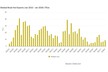
In the higher belts of South Kashmir, almond orchards that once covered areas such as Khiram, Sirhama, and Marhama have largely disappeared over the past two decades. Traditionally grown on karewa slopes under cooler climatic conditions, almonds were a dry fruit crop suited to upland production zones. Much of this area has now been converted to apple orchards or non-agricultural use.
Growers report that the decline has been gradual. Falling prices, erratic yields, climate variability, and the expansion of high-density apple plantations have all influenced planting decisions. "Earlier, almonds were considered reliable in these higher belts," said Abdul Hameed, an orchardist who has since switched to apples. "But year after year, production declined. Eventually, it stopped making economic sense."
Data from the Department of Horticulture illustrates the reduction in acreage. In the Bijbehara and Srigufwara sub-divisions of Anantnag district, almond orchards covered about 225 hectares in 2008 to 2009, with an output of 112 metric tonnes. From 2015 to 2016, the area had declined to 150 hectares and production to 80 metric tonnes. In 2016 to 2017, cultivation was reduced to eight hectares, with production at eight metric tonnes. This level remains unchanged from 2025 to 2026.
Horticulture officials confirm a long-term contraction in almond acreage across South Kashmir. Farmers cite untimely rainfall during flowering, snowfall, and late spring frost as key risks affecting fruit set. Warmer winters have also reduced chilling hours required for consistent yields.
"Inclement weather during blooming, frost damage, uneven rainfall, and the shift to more remunerative enterprises like high-density apple plantations have all affected almond cultivation," said Dr. Suhail Nazir Bhat. He added that limited market infrastructure, competition from imported almonds, particularly from California, and restricted access to quality planting material have also constrained the crop.
Pest pressure and fungal diseases have increased, according to growers, while technical support for almonds has remained limited compared to apples. "The almond crop has a long gestation period and uncertain returns," said Waqar Ahmad, an orchardist from Bijbehara. "Apples, on the other hand, offer quicker and more predictable income, especially with improved varieties and better market access."
Apple cultivation has benefited from subsidies and extension services, supporting the transition towards high-density systems. Imported almonds dominate retail channels due to uniform size and availability, while local production has faced declining demand.
The reduction of almond orchards reflects a structural shift in the region's horticultural model.
Source: GreaterKashmir